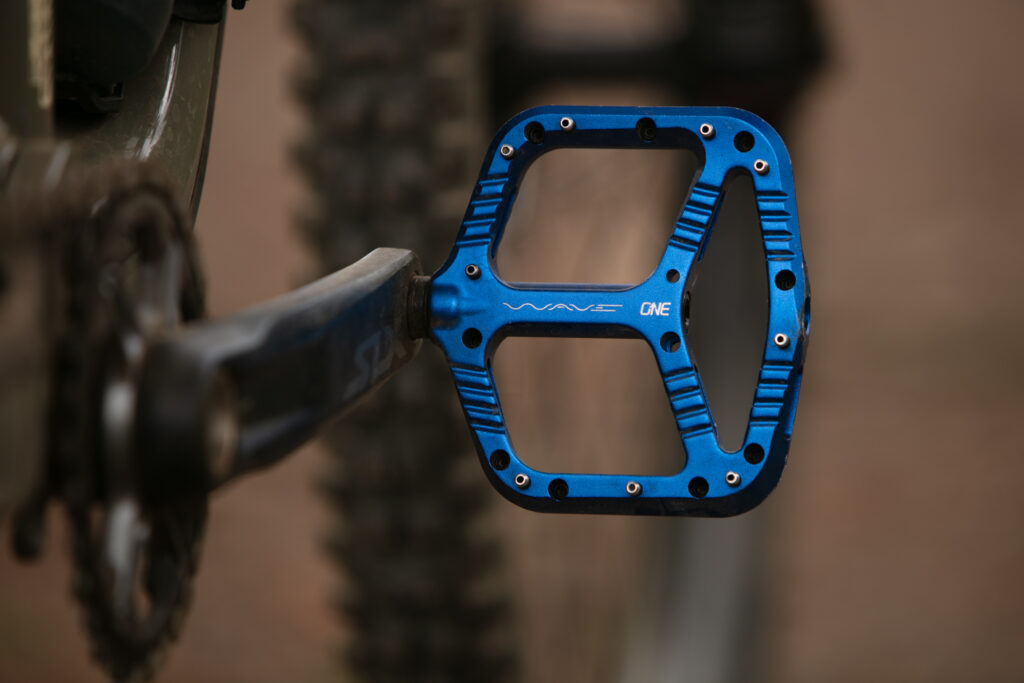

OneUp Components has done something rather different with its Wave Pedals. By combining both concave and convex profiles, they live up to their name, resulting in a wave-like shape that works surprisingly well, given that the humble flat pedal has hardly changed for years. With that, the Wave pedals are incredibly comfortable while providing huge security and stability. Though if I were to really find fault, it wouldn’t hurt if the platform were a little larger.
- Best mountain bike pedals 2025 – the best options from XC to Enduro
- Crank Brothers Stamp 1 Gen 2 flat pedal review
- Are flat pedals worth it?
OneUp Components Wave Pedals – Technical details
As OneUp says, nearly every pedal on the market is completely flat, convex, or concave. Each of those provides a specific ride feel that some will love, and others will hate. With the Wave pedal, the brand not only aims to provide the best of both worlds, but by combining a convex and concave profile, it reckons it can bring big performance benefits to a flat pedal.
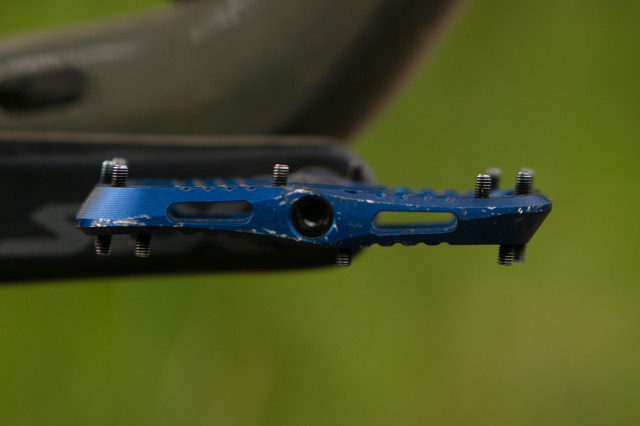
At the foremost edge, the Wave is concave, and at the rearmost, it’s convex. With that, the Wave is designed to promote and heels-down riding position, which is a common technique when riding with flat pedals. The brand also says that it makes for a more natural pedal stroke.
That wavey pedal body is constructed of forged, then CNC-machined 6061 aluminium, and it rotates on a chromoly steel axle that’s finished with a black ED coating. Allowing the pedal to spin are then three outboard cartridge bearings per pedal, paired with a single igus bushing inboard.
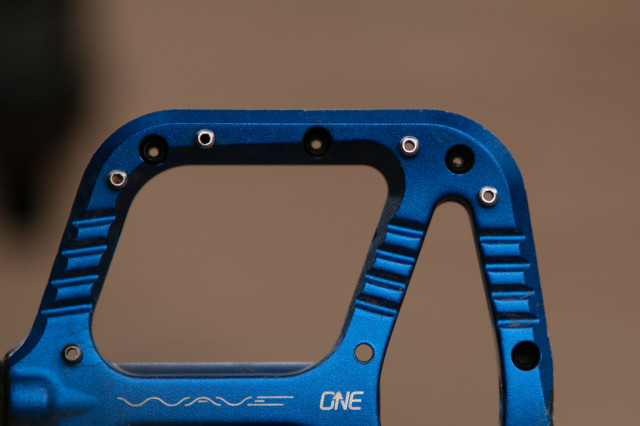
As for pins, there are 10 per side and they’re hollow, in a bid to encourage mud clearance.
Weighing in at 356g (355g claimed), the Wave pedals are available in nine colours. They then measure 107mm in width by 110mm in length. OneUp then says that the pedal is 14.2mm deep at the axle and 11.5mm around the edges.
OneUp Components Wave Pedals – Performance
I’m all for pedals that push the boundaries a bit, and while the Wave pedals definitely do so, in my mind, they make perfect sense. To be honest, I can’t quite believe that no one else has done this before.
At face value, they’re incredibly similar to OneUp’s Aluminium Pedals, certainly in their shape, but the big difference comes in their profile. Upon the first step of the Wave Pedals, they felt incredibly natural as the profile hugs the foot’s contours almost perfectly.
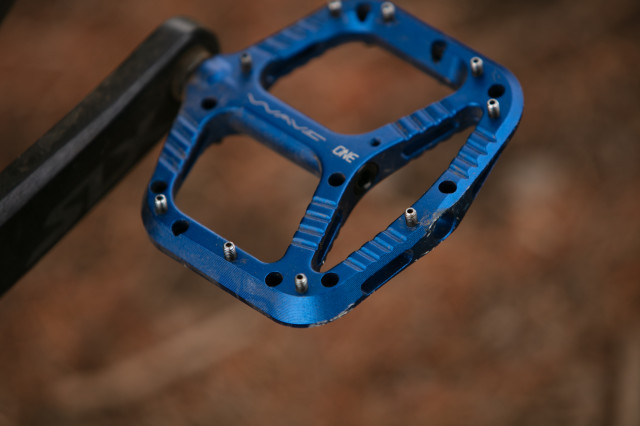
The convex portion supports the foot’s arch, while the convex cradles the ball of the toe. The result is a very natural and incredibly comfortable feel. Although OneUp mentions that the profile can provide a better pedal stroke and while I don’t disagree, any gains in this respect are certainly marginal. But one thing’s for sure, it’s a super comfortable pedal. Then, because the pedal follows the natural form of the foot, it does an excellent job of staving off fatigue during extended descents.
With fairly lengthy pins and a somewhat broad platform, it comes as no surprise that traction on the pedal is abundant. However, this is where the pedal’s kooky profile really comes into play, especially with the heels-down position that’s needed for trail-riding success. The convex portion of the pedal almost gives the foot something to hang onto, which helps all of the pins sink into a shoe’s sole. The result here is ridiculous stability. The big downside of many flat pedals is that a foot can shift when riding through harder hits, but with the Wave, I’ve never experienced such an event. Its security is nothing short of excellent.
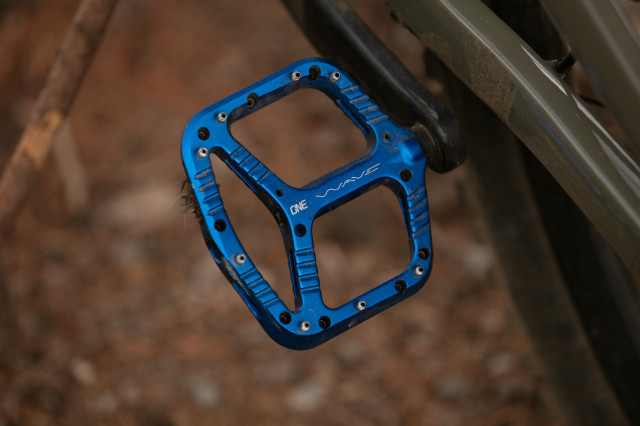
I have, however, found myself wanting a little more width from the pedal. That’s just to help achieve a solid connection with the pedal on the first go. This is merely a minor point, however, and it certainly won’t stop me from threading them onto any bike I can.
Generally, I’m a fan of pedals with a completely flat profile because others don’t quite provide the full sole connection, and I think that concave profiles can feel a little weird. However, the Wave Pedals manage to offer the sure-footedness of a concave pedal, but with the connection I look for in a flat profile. The whole of a shoe’s sole is in complete contact with the pedal, which means excellent feel and communication through the Wave.
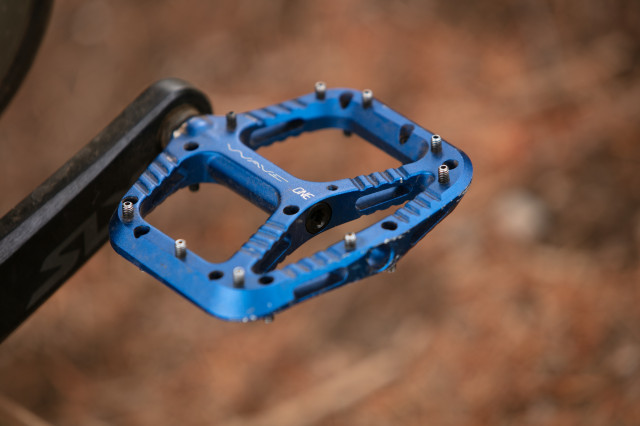
I’ve been riding these pedals for a good few months now, and while they’ve definitely picked up a few harsh-looking scratches on the platform, durability is looking rather good. The bearings still roll as they did when new, and they’re far from showing signs of needing a service. When the time comes, OneUp provides a bearing nut tool in the box and plenty of spare pins, so an at-home service should be straightforward. Oh, and those pins are bottom loading, so they’re easy to remove should they shear.
OneUp Components Wave Pedals – Verdict
The Wave pedals’ £150 price tag puts it amongst many of the best pedals on the market, and there are an awful lot to choose from. However, thanks to its unique (and patented) profile, it offers something different to that crowded space.
Another pedal that does things somewhat differently is Race Face’s Turbine pedal. It uses a concave profile, but it’s very deep, at 3mm. It offers a similar level of security, but it has very long pins, so when you need to adjust your foot position, it can be very tricky. Plus, that deep concave may not suit everyone. The Turbine comes in at £170, too.
At £147 is PNW Components’ Loam pedals. These again try to combine both convex and concave profiles, but in a much more subtle way. We’ve got these in for test as we speak, and while they’re very good, the Wave’s more pronounced profile brings a heightened level of comfort.
OneUp Components’ Wave Pedals do the whole flat pedal thing a little differently, but because of that, they’ve quickly become some of my favourites. They provide a level of comfort that I’ve not found with any other pedal, while delivering excellent grip and durability. If, like me, you like a flat profile but want more stability, definitely take a look at the Waves.
All the deals displayed on our review pages are pulled from a constantly updating database feed of the best affiliate deals available. The criteria for deciding on what are the best deals is who is offering the lowest, delivered price. In most cases we will be showing the very best deal available online, but sometimes you may be able to find an item cheaper. If you can please feel free to post a link in the comments box below. To find out more about affiliate links on road.cc click here.