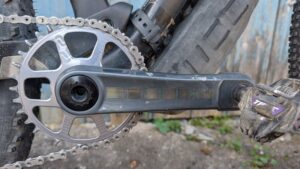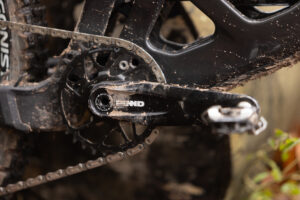

Is this the best carbon crankset on the market? With its sleek aesthetics and perfect tolerances, it stands out as much for its looks as it does for its performance. The only real drawback is the premium price tag.
Hope Carbon Crankset – Technical details
Hope would likely agree that this crankset hasn’t been designed solely with low weight in mind—often the primary assumption when it comes to carbon components. Instead, its construction prioritises strength and vibration damping, with weight savings a welcome secondary benefit.
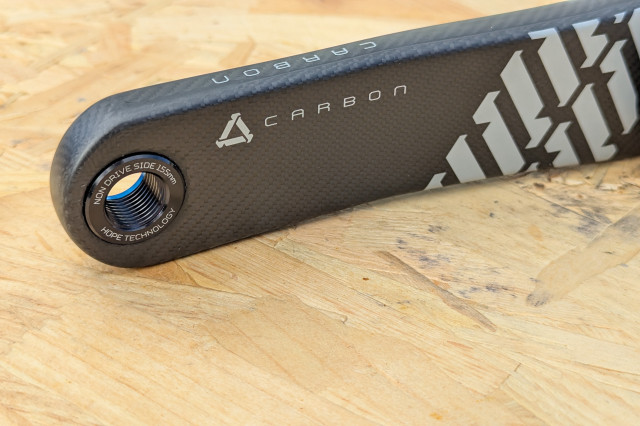
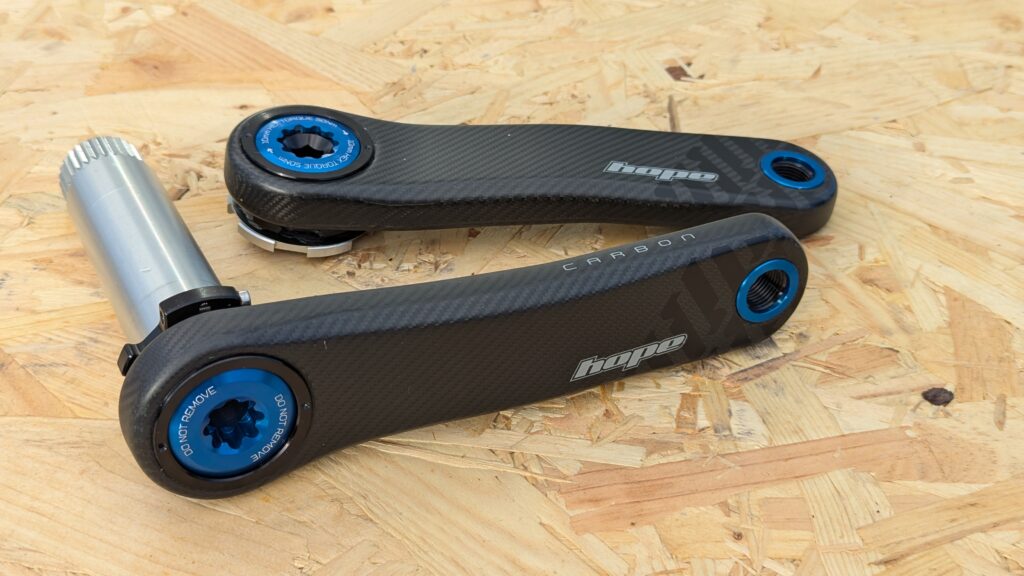
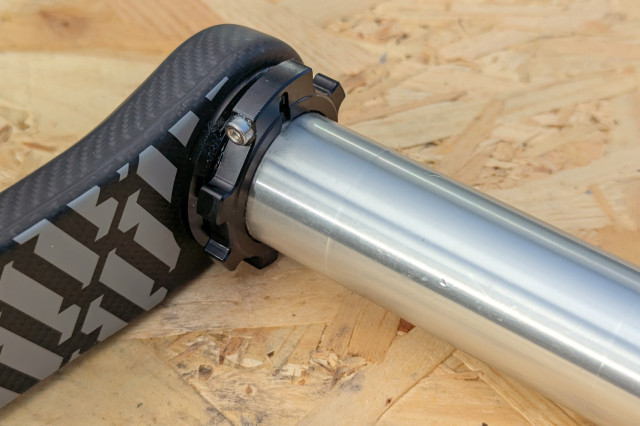
The crank arms feature an internal layup of T700 carbon fibre and a foam core, topped with a 1K weave outer layer that gives a premium, refined finish. A choice of coloured accents around the pedal thread inserts and self-extracting bolt area allows the crankset to be matched with other components in Hope’s range. Six colour options are available: black, silver, blue, red, purple, and orange.
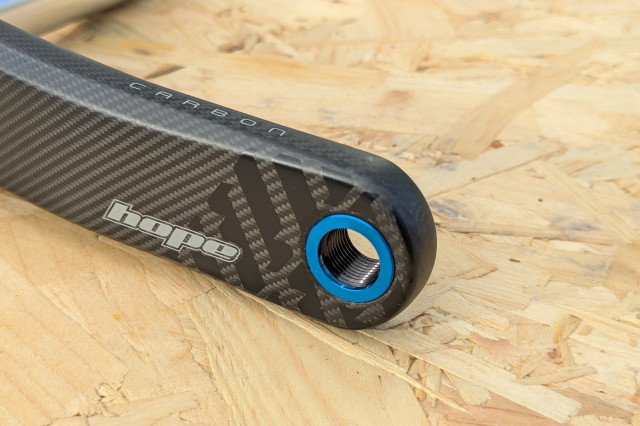
Carbon cranksets have occasionally suffered from issues where pedal thread inserts are permanently bonded and prone to failure over time. Hope has tackled this by making the inserts replaceable, effectively eliminating the risk of bonding failures and extending the service life of the crankset in the event of damage or wear.
The crankset is available in 155mm, 165mm, and 170mm arm lengths, making it one of the very few carbon options to offer a 155mm length. The 30mm aluminium axle is offered in several lengths to suit various chain lines for MTB standard, Boost, and Super Boost, and Hope provides a comprehensive guide to help users choose the correct configuration.
The 30mm axle is supported with virtually all bottom bracket standards, and Hope has standard and ceramic BB options for press-fit and threaded frames.
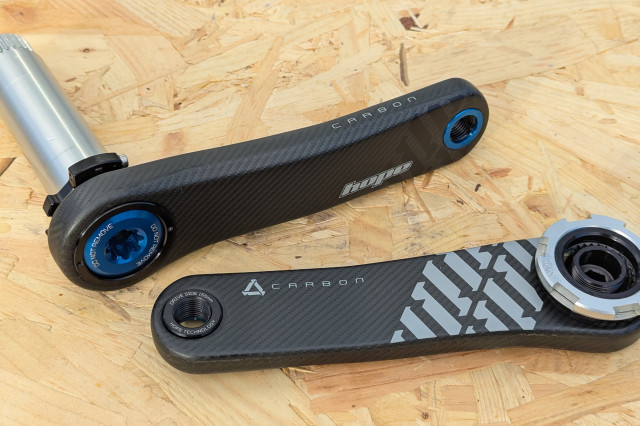
Hope lists a claimed weight of 422g for the crankset. The sample on test, with 155mm arms and a 156mm axle, weighed in at 419g—split as 247g for the non-drive-side arm and axle, and 168g for the drive-side arm. The crank arms are supplied with rubber end protectors, weighing 10g per pair. A 34-tooth direct-mount chainring adds 75g, bringing the total system weight to 490g, or 500g with the protectors fitted.
The maximum combined rider and bike weight is 130kg, though Hope provides specific weight limits depending on the intended riding discipline—trail, all-mountain, or enduro.
Hope Carbon Crankset – Performance
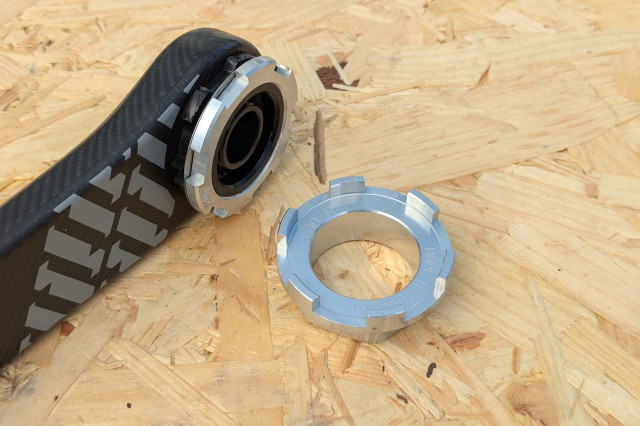
Fitting the crankset was straightforward, with all components having precise construction and tight tolerances. The self-extracting bolt mates perfectly with a Werx 10mm hex wrench, with no unwanted play. When paired with a Hope press-fit bottom bracket, there was no lateral movement or play against the bearings. Installing the chainring was similarly hassle-free, and it’s a welcome touch that Hope includes the required lockring tool in the box — something not all brands provide. The tool itself also fits precisely, ensuring a secure installation.
The crank arms come with optional rubber end protectors, which are quick and easy to fit if you choose to use them. Hope also supplies clear protective film for the face of each arm — a common addition for carbon cranksets, though it’s often factory-applied by other brands. In this case, the film is thin and the adhesive is weak, with some peeling that began after only a few rides, and I soon had to remove it.
While this film won’t be a concern for every rider — it’s mainly there to guard against heel rub — it’s still a useful inclusion to help preserve the carbon finish over time. Factory application or a higher-quality adhesive would likely result in a neater and more durable finish.
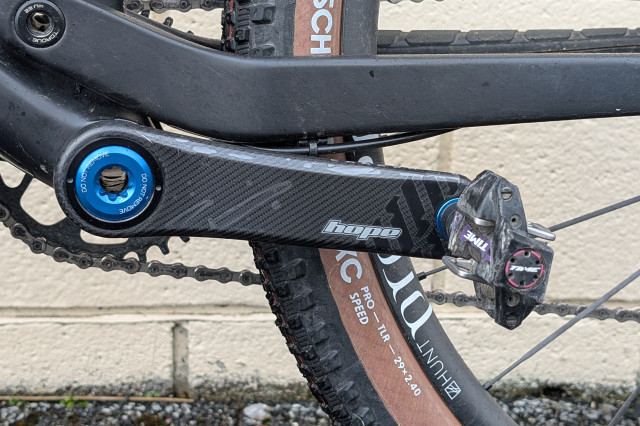
Out on the trail, the crankset performed faultlessly. It quickly became one of those components that simply does its job and fades into the background — a good sign. Even when deliberately trying to detect flex or compromises under load, the cranks delivered consistent, solid performance. Hope claims the construction is designed to dampen vibrations. While I’ve not had significant issues with vibration from other cranksets, the Hope Carbon felt equally composed and comfortable.
The availability of different axle lengths and the adjustable chainline, when used with Hope’s spiderless chainrings, helps future-proof the crankset. Given Hope’s strong track record for supporting legacy components and providing spares, it’s reassuring to know this crankset should remain compatible regardless of how standards evolve.
For those chasing grams, there are lighter options on the market. The e*thirteen XCX Race, for instance, claims a sub-360g weight; it is over 50g lighter than the Hope Carbon. Among more mainstream offerings, the SRAM Eagle XX1 DUB SL comes in at 433g, while the Shimano XTR lands at 472g. However, most alternatives offer fewer length options; even SRAM’s expanding range still bottoms out at 165mm within the XX1 SL line.
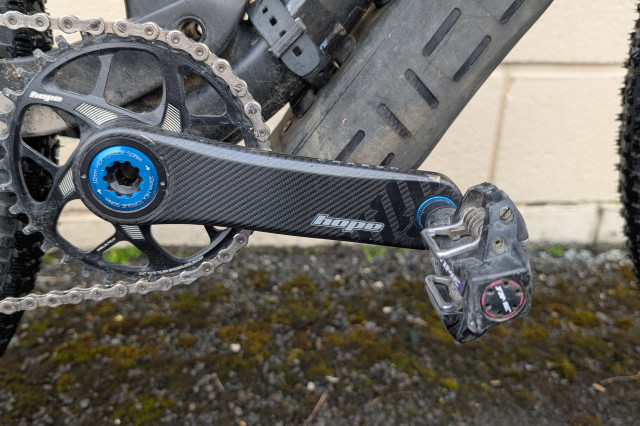
That said, the real-world performance gains between these cranksets are likely marginal. Crucially, I encountered no notable drawbacks with the Hope Carbon, and the replaceable pedal thread inserts give added peace of mind by eliminating a known weak point in many carbon cranksets. The flawless 1K carbon weave finish adds a final touch of refinement.
Hope Carbon Crankset – Verdict
The only real drawback is the price, especially given that Hope’s own aluminium Evo crankset offers strong competition within the brand’s line-up. While Hope hasn’t published lab data, I’d expect the Carbon version to outperform the Evo in terms of stiffness. On the trail, though, the difference is negligible. With the Evo priced at £285 — less than half the cost of the Carbon — it’s a compelling alternative.
Looking beyond Hope’s range, the Race Face Era costs £449 and is available in 160–175mm lengths. The e*thirteen XCX Race, priced at £440, is lighter but aimed more at XC riders, and limited to 170 and 175mm sizes. Notably, both these options use bonded-in pedal inserts, unlike the Hope.
If Hope were to factory-apply the protective film or improve the adhesive quality, there would be little to criticise in terms of performance. The Carbon crankset looks superb — and that’s exactly how you’ll want it to stay. Beyond the visual appeal, it delivers impressively across stiffness, weight, durability, and serviceability, with custom colour options to match your build.
You might also like:
- 7 trailside fixes every cyclist should know
- 5 Ways to tweak your mountain bike’s geometry – Frame
- SRAM MTB drivetrains 2023: SX to XX SL explained
Product purpose:
The Carbon crank has been designed to maximise the advantages of carbon fibre, through a unique construction method whilst using very small aluminium inserts to keep weight down. This, coupled with an optimised lay-up, ensures a good balance between ride feel, stiffness, and isolation from trail chatter.
Build extra:
>> Tuned stiffness characteristics for optimum ride feel
>> 1K outer fabric has greater abrasion resistance and gives the unique ‘Hope’ carbon aesthetic
>> Replaceable pedal thread inserts
>> Foam core helps to absorb impacts and dampen vibrations
>> T700 fibres for optimum strength to weight
>> Unique carbon construction method
>> Proven self-extracting axle/arm interface from our EVO cranks
>> 155, 165 & 170mm length
>> 30mm oversize 7075 aluminium alloy axle
>> Configurable for 52 and 55mm chainlines
>> Weight from: 156mm 422g w/o chainring, 487g with 32t chainring
>> Direct mount chainring only, Spiderless Retainer chainrings 28T to 36T
>> Q‐Factor 168mm Boost/176mm 55mm
>> Recommended use Trail/All mountain
Product construction
Product construction extra:
Product performance
Product durability
Product durability extra:
Product weight
Product weight extra:
Product comfort
Product comfort extra:
product value
All the deals displayed on our review pages are pulled from a constantly updating database feed of the best affiliate deals available. The criteria for deciding on what are the best deals is who is offering the lowest, delivered price. In most cases we will be showing the very best deal available online, but sometimes you may be able to find an item cheaper. If you can please feel free to post a link in the comments box below. To find out more about affiliate links on road.cc click here.