


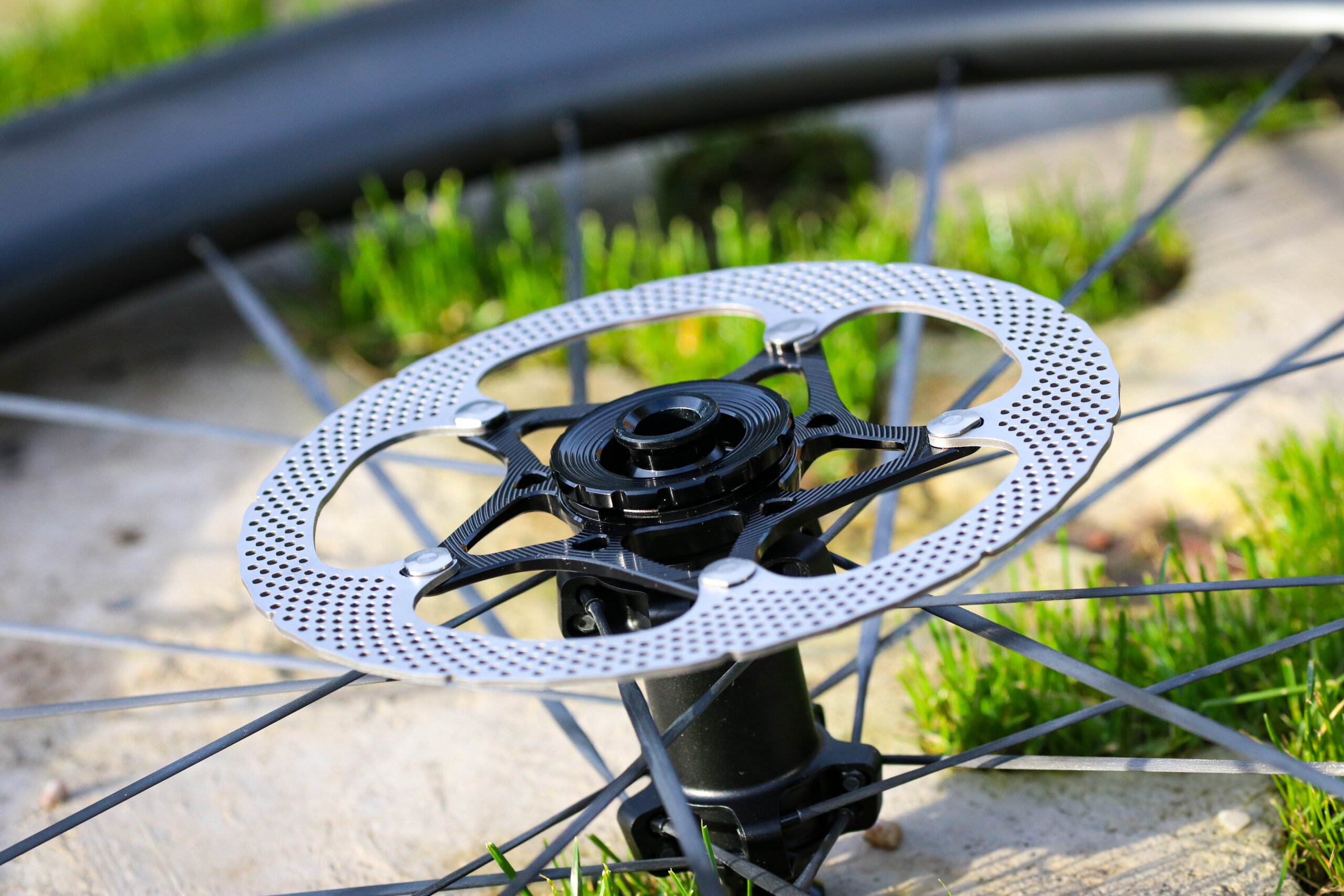


Sometimes it’s the empty space that makes all the difference. The courtyard in a historic building; the gaps between the guitar chords in an AC/DC riff; for cyclists, the crucial rest and recovery time after a hard session on a bike. Nothing is ever really nothing.
Well, when it comes to disc brake rotors for bicycles, it turns out that where you position the holes is far more important than people might think! Have too little steel along one circular path compared with the paths beside it, and that part of the rotor can overheat and take part of the brake pad with it. As temperatures rise, braking performance can suffer precisely when it’s needed most.
One brand that has spent more than a decade investigating this is absoluteBLACK.
Perhaps best known for its innovative approach to oval chainrings, absoluteBLACK has spent years exploring how the size and placement of disc rotor holes affect performance. It believes it has identified an overlooked reason why the perforation pattern of a disc rotor can have such a profound effect on braking performance.
What began as an exercise in reducing rotor weight eventually led to a much more interesting discovery: it’s not just how much steel you remove from a rotor, but exactly where you remove it.
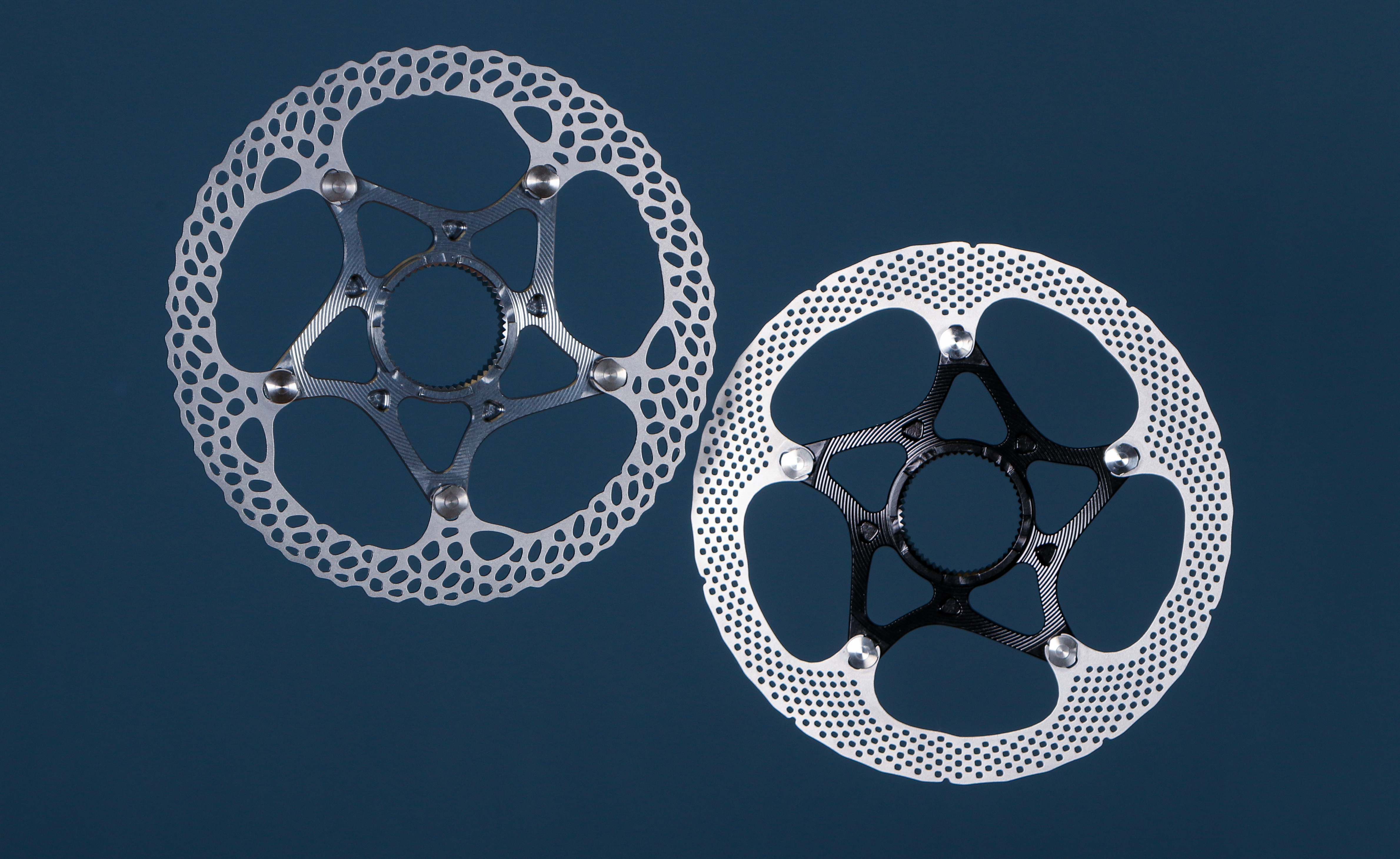
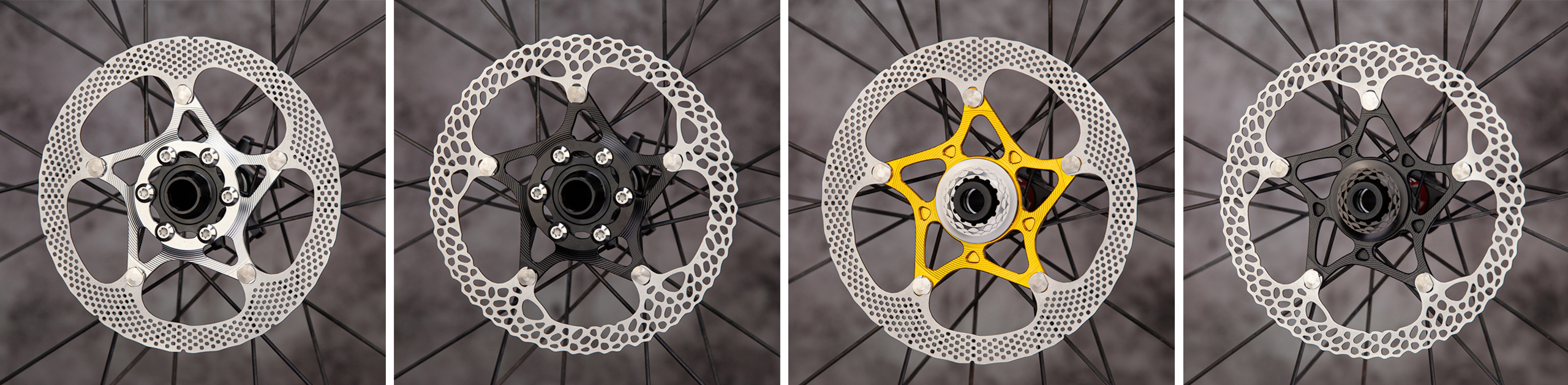
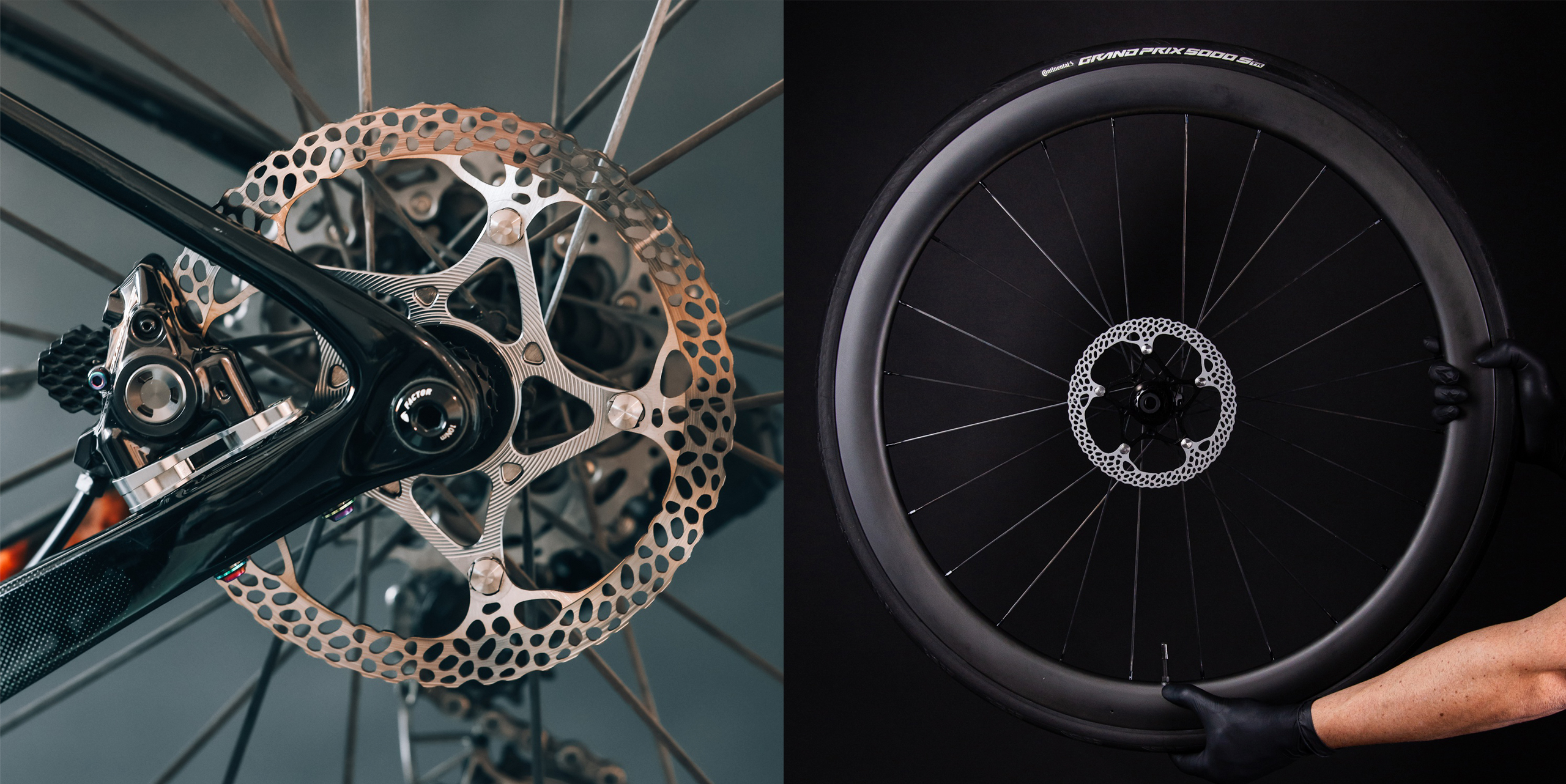
The end result is absoluteBLACK’s RAVEN range of new-generation, full-floating disc rotors. And the unique thing about RAVEN rotors is that every hole has been positioned to make the amount of braking surface seen by the pad as equal as possible across the rotor. It sounds simple, but achieving it took years of experimentation, extensive testing and an entirely different way of looking at rotor design.
So let’s examine the full story behind their creation and find out why you’ll never look at a brake rotor the same way again…
More than weight
The new RAVEN SL and RAVEN GT are the result of the longest product development in absoluteBLACK’s history. Back in 2012, when the original Center Lock RAVEN was released, it attracted attention for its exceptionally low weight. But at the time the market for high-end road disc components barely existed.
Undeterred, absoluteBLACK continued experimenting with the concept and repeatedly returned to one deceptively difficult problem: how much material can be removed from a rotor without compromising its braking performance?
The answer would only become apparent years later, during the development and extensive testing of the brand’s GRAPHENpads. What initially looked like ordinary uneven wear turned out to reveal something much more fundamental about the way holes are distributed across a rotor’s friction surface.
Making a light rotor is relatively straightforward. The friction track represents a significant proportion of its mass, so cutting more and larger holes quickly reduces weight. But removing material in the wrong places means that braking performance can deteriorate dramatically, particularly as temperature rises. Every hole removes not only mass, but also part of the surface available to absorb and dissipate the heat generated during braking.
For a long time, predicting which perforation patterns would work well required extensive empirical testing. Two patterns could remove a similar overall amount of steel yet behave very differently under braking. absoluteBLACK wanted to understand why.
The problem hiding in the holes
Lots of rotor testing, and later the development of GRAPHENpads, eventually pointed the company toward an answer: localised overheating caused by an uneven distribution of available braking material across the height of the friction track.
A brake pad applies pressure across the entire track. But if one narrow circumferential path contains substantially less steel than the paths immediately beside it, that area has less material available to absorb and dissipate the heat generated through friction. It therefore becomes thermally overloaded relative to its neighbours.
As temperature increases, the corresponding area of the brake pad can also overheat. With organic friction materials, excessive temperature can cause glazing and a substantial reduction in coefficient of friction. Part of the rotor and pad surface effectively contributes less braking force just when more braking is being demanded. The rider then applies greater lever force, generating yet more heat and further accelerating the problem.
This, absoluteBLACK believes, is one of the reasons why a rotor that looks perfectly adequate on paper can perform very differently from another rotor with the same diameter and similar overall mass.
The testing also provided an important clue: the same localised areas that were being thermally overloaded also tended to wear faster. Over time, they became visible as the familiar deep concentric grooves found on many used rotors. The grooves weren’t the problem. They were a map of the problem.
What does the brake pad actually see?
To fully understand what is happening requires looking at the braking surface in a different way. Rather than considering the holes as a two-dimensional pattern, absoluteBLACK virtually divides the friction track into hundreds of circular paths of progressively increasing diameter.
Take one of those paths – 145mm in diameter, for example – and follow it for one complete revolution. Where the path crosses the rotor there is steel. Where it crosses a perforation there is a gap. The combined length of all those gaps can be subtracted from the complete circumference to calculate exactly how many millimetres of steel are available to that particular part of the brake pad during one revolution.
The calculation is then repeated across the height of the entire friction track. Plot rotor diameter on the horizontal axis and available steel on the vertical axis and the distribution suddenly becomes visible.
On many conventional rotors, the resulting line rises and falls dramatically. One circumferential path can contain several times more available steel than another only a few millimetres away. For absoluteBLACK, this was the missing connection between hole geometry, localised temperature, braking performance and the wear patterns observed during testing.
Easy in theory, hard in reality
The objective for RAVEN, therefore, became clear: every circumferential path across the main working area of the friction track should provide as close as possible to the same total length of steel. According to absoluteBLACK, an ideally balanced braking surface should produce something very specific: a line as close to horizontal as possible.
There are unavoidable structural limits of course. More continuous material is required around the outer perimeter of the rotor for structural integrity and where the friction track transitions into the load-bearing arms. The graph therefore rises at both extremes. Across the main working area between them, however, the objective is to make the line as flat as practically possible.
But while understanding the objective is relatively simple, achieving it is considerably more difficult. As rotor diameter increases, so does its circumference. This means progressively more total material must be removed toward the outside of the friction track simply to maintain the same length of available braking surface.
In other words, the holes need to be deliberately uneven geometrically to create an even braking and thermal result.
Changing a single hole also affects many neighbouring circumferences simultaneously. Correcting a trough in one part of the graph can create a peak somewhere else. The process becomes an iterative cycle of designing the pattern, calculating it, studying the graph and modifying the geometry again.
New tools for a new approach
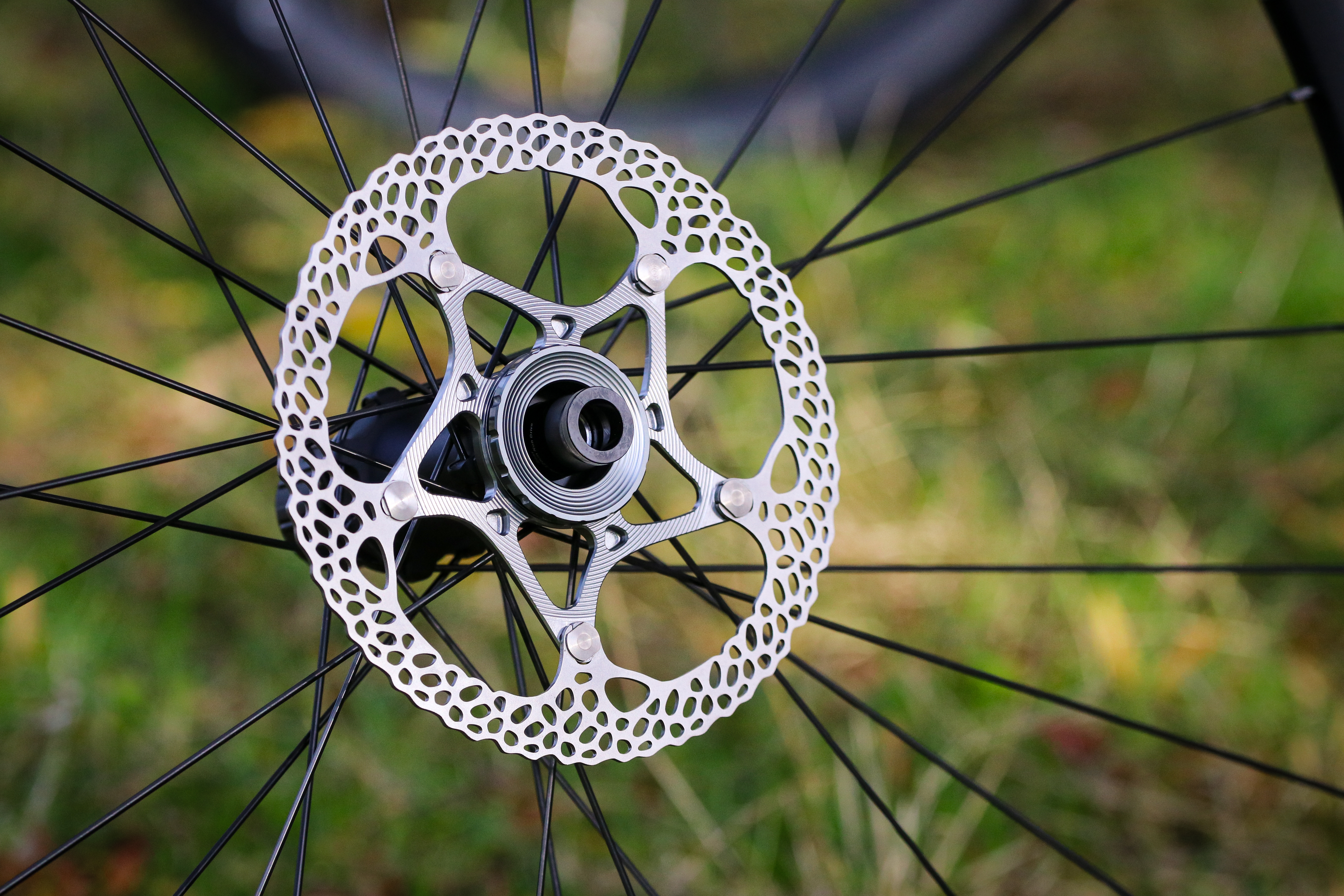
For precisely this purpose, absoluteBLACK developed dedicated software. The software does not generate the hole pattern. Instead, it analyses each manually-designed configuration across hundreds of circumferential paths and immediately reveals where too much or too little material remains. This also explains one of RAVEN’s most obvious visual characteristics: its large number of relatively small perforations.
A 4mm circular hole affects approximately 4mm of the radial height of the braking surface. As a virtual circumference passes through it, the intersection starts small, becomes progressively larger toward the centre of the hole and then decreases again. One large hole therefore creates a relatively broad disturbance in the graph.
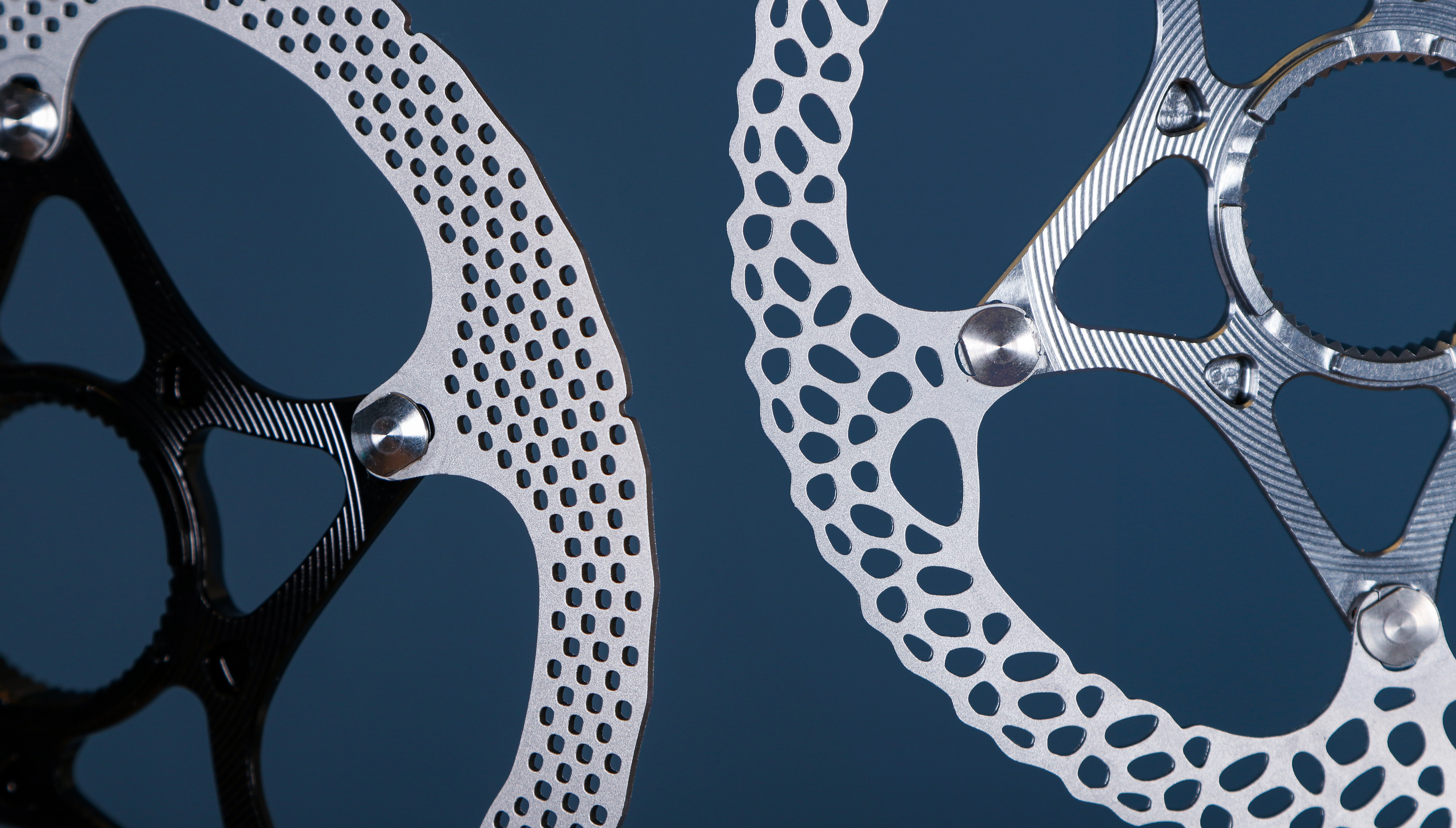
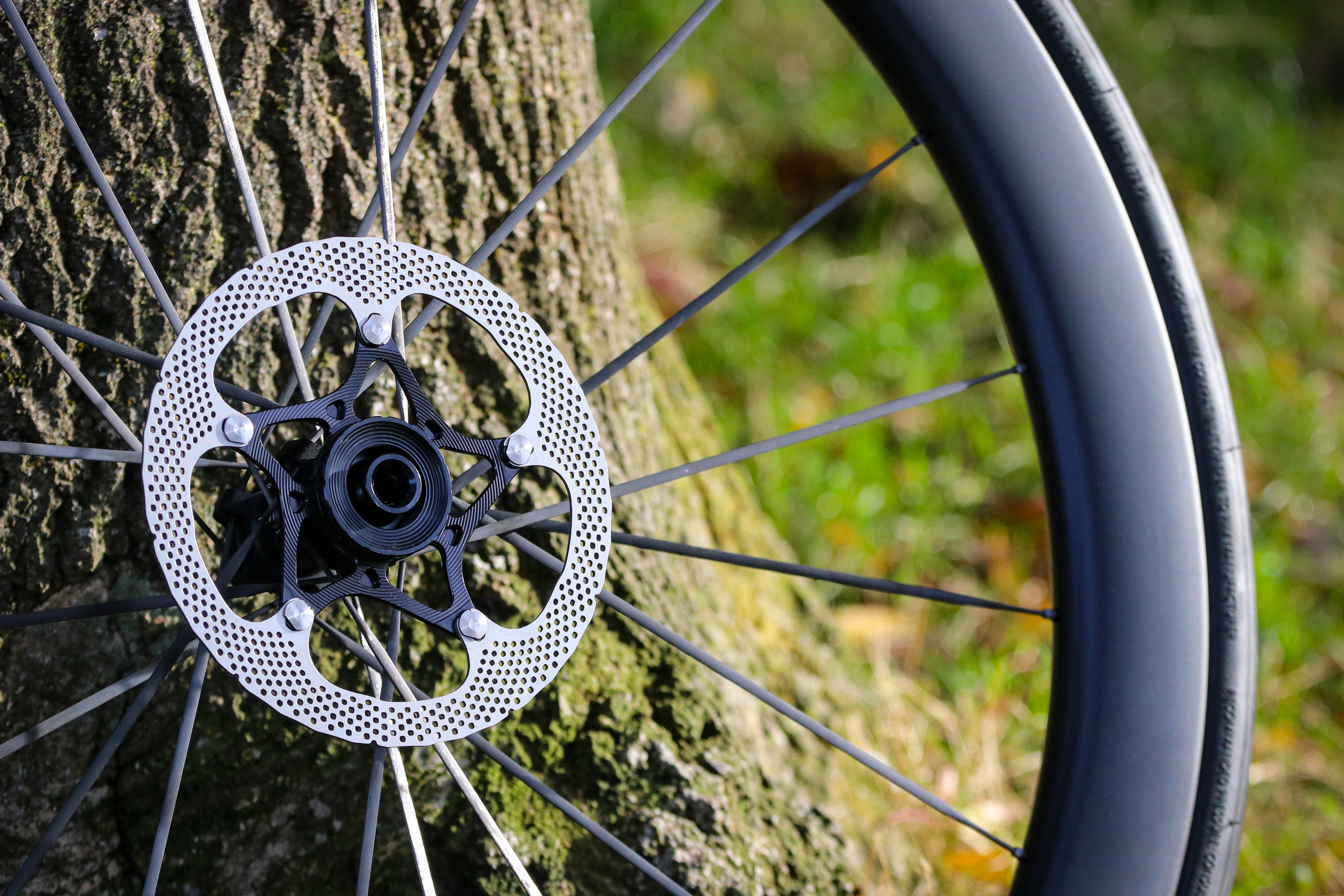
Smaller holes provide much finer resolution. Material can be removed in smaller increments and at more precise radial positions, allowing neighbouring circumferences to be balanced far more accurately. RAVEN GT takes this principle furthest, using more than 500 individual perforations.
But simply drilling hundreds of small holes is not the solution. Their size, shape and exact position all influence multiple neighbouring paths, so the final pattern is the result of hundreds of calculations and design iterations. The objective is a mathematically uniform braking path, rather than a visually uniform pattern.
Why isn’t every brake rotor designed this way?
Manufacturing is part of the answer – large holes and simple geometric shapes are considerably easier and more economical to produce.
Stamping imposes practical limitations on minimum radii and hole geometry (4mm), while laser cutting provides greater freedom, but becomes progressively more time-consuming as the number and complexity of cutting paths increase. In other words, conventional manufacturing methods have influenced rotor geometry in ways riders might never have considered.
RAVEN approaches the problem from the opposite direction: the required distribution of braking material determines the geometry first, and the manufacturing process has to accommodate it.
During development, absoluteBLACK also found that hole distribution is only one part of rotor performance. Steel hardness, hole shape and orientation, repeating patterns capable of generating harmonic noise, the ratio between removed and remaining material, laser technology and even the grinding process used to finish the friction surface can all influence braking behaviour.
Both new RAVEN models additionally use a two-piece full-floating construction, allowing the stainless-steel friction ring to expand relative to its carrier as temperature rises and helping to limit distortion during repeated heating and cooling cycles.
Tested performance
The new RAVEN was independently tested for brake performance and heat resistance by German bicycle testing laboratory EFBE Prüftechnik GmbH. EFBE’s dedicated test equipment isolates the braking system and directly measures operating force and brake torque under controlled conditions.
During the heat-resistance test, the absoluteBLACK combination dissipated 92.7Wh of braking energy. A Shimano Dura-Ace reference combination tested using the same procedure recorded 92.9Wh.
The near-identical heat-resistance result is particularly interesting because the two rotors approach thermal management very differently. Shimano uses its Ice Technology approach, while RAVEN relies on a stainless-steel friction track, full-floating construction and carefully controlled perforation geometry.
Brake torque was also independently measured. After bedding in, RAVEN with GRAPHENpads generated 241Nm at 140N lever force, increasing to 274Nm at 160N. The Dura-Ace reference combination generated 211Nm at 140N, at which point further lever travel was limited by contact with the handlebar. These figures are presented as results of the complete tested brake combinations rather than as a rotor-only comparison.
Two RAVENs, one principle
RAVEN SL and RAVEN GT use exactly the same underlying design principle, but apply it with different priorities.
RAVEN SL uses fewer and somewhat larger perforations to remove more material and reduce mass while still maintaining a carefully controlled distribution of available braking surface. RAVEN GT uses more than 500 smaller perforations for finer control, together with additional material and greater thermal mass in the carrier for more demanding and prolonged braking.
6-bolt
- RAVEN SL 160mm: 85g
- RAVEN GT 160mm: 99g
Center Lock
- RAVEN SL CTRL 140mm: 81g
- RAVEN SL CTRL 160mm: 94g
- RAVEN GT CTRL 160mm: 108g
RAVEN SL and GT are both light rotors, but the objective was to understand where steel is needed for braking, and where it can be removed without compromising it.
For more information, head to absoluteblack.cc