[Photography by Steve Thomas]
Even before it was officially released at the end of 2025 the Canyon Deflectr RLS trail helmet has been topping the Virginia Tech cycling helmet charts in terms of helmet safety, and it does indeed come packed with statistically proven safety features that no other MTB helmet can lay claim too, and there’s a fair bit more to this helmet too – is it really the safest cycling helmet in the world right now?
- Best mountain bike helmets 2025 – top-rated head protection for the trail
- Canyon Disruptr helmet review
- Can you use a road bike helmet for mountain bike and gravel riding?
Canyon Deflectr RLS – Technical details
The first of the relatively new and lauded safety features is the HighBar 1.5 fastening system, which is the updated version of the system used on the Canyon Disruptr I reviewed last year, and as of now, Canyon is (as far as I’m aware) still exclusively incorporating this in MTB helmets – though other brands are expected to follow on.
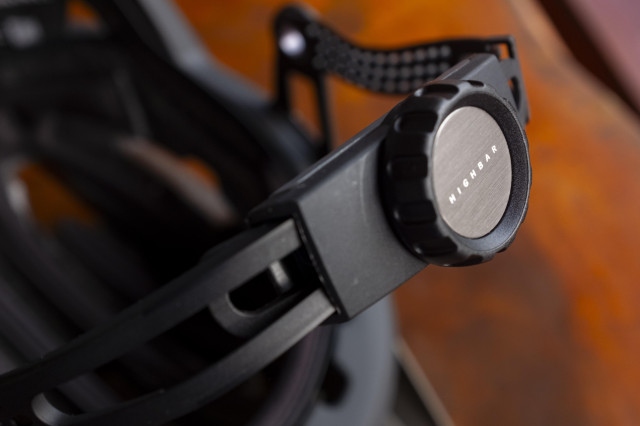
In essence, it’s a two-part system; the inner cradle with a rear twist dial and three-slot height adjuster, which effectively cradles your head, ensuring that the helmet sits perfectly straight and safe. The other half of the fastening system is the slide-down and dial-fastening single rigid nylon arm, which replaces regular straps.
The brand-new headline feature is the RLS (Release Layer System), which is produced by HEXR, the company that created it and currently has the only other cycling helmet with the technology in, the urban/road MIDEN RLS, a regular strapped helmet that sits just behind the Deflectr in the Virginia Tech charts.
RLS is basically a whole load of 2mm polycarbonate ball bearings (estimates vary between 600-2000 of them) which are bonded to a pad and then the helmet, and beneath the outer shell. These are found on the most impact-prone panels only. In case of a “considerable” impact, the bearings will move and break the bonding between them and the panels. Then the panels will come off, and the bearings will follow. The exact impact force needed for this is unknown, but a drop or banging your head on a door frame should not release them, and I have tried a few tiled floor drops with no issues.
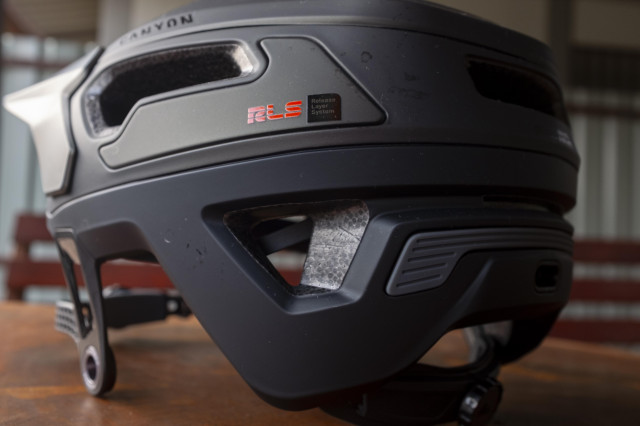
This system has, in the labs, proven to reduce rotational friction between your head/helmet/ground and drastically reduce the chances of head/brain/concussion injury, with some labs measuring this reduction being up to 63% more than Mips-equipped helmets and up to 84% more than regular non-MIPS helmets – so, three to four times less likely to be serious. Though in real-world use, and depending on how you bang your head, this will differ, which is very impressive, however you look at it. On the downside, although the panels can be reattached, the helmet will need replacing after this to remain fully effective, and the bearings from the impacted panels will be scattered on the trail.
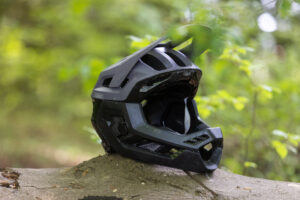
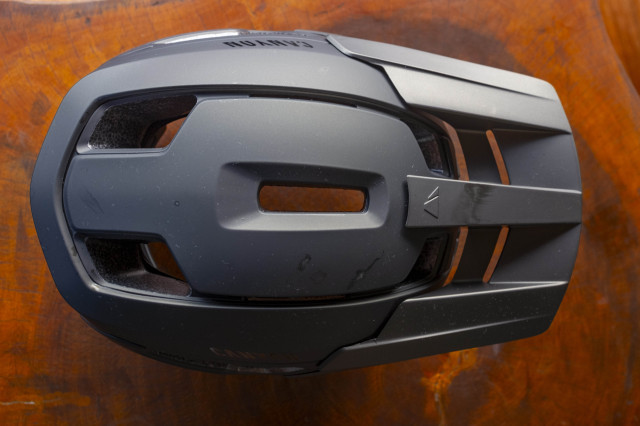
The upper helmet is EPS foam with a polycarbonate shell, has good rear coverage, and is currently available in matte black, desert (sand) and metallic olive (as tested), with other colours due imminently. There are 18 vents, with bigger top vents, a three-position peak, an eyewear front holder in the vent slots, a rear goggle grip and a port for the Canyon magnetic rear LED strip light (sold separately). The inner pads are detachable and quite robust, but don’t cover the rear of the helmet, which is where the three-position height adjuster and the rear ratchet fastening dial are.
Canyon Deflectr RLS – Performance
After almost a month of intermittent use in very hot conditions (someone has to test the ventilation), I’ve formed some opinions and views on the Canyon Deflectr RLS, which are always personal to the tester and their head shape/sensitivity. I also reviewed the Canyon Disruptr a while back, which had the original HighBar, so I am used to the system and the brand’s venting approach. Thankfully, as of yet, I’ve not had to test either helmet to the serious crash limit, which is when you truly find out if the hype tallies with the outcome.
The HighBar system is the visual attention grabber, and the new HighBar 1.5 is a vast improvement in terms of comfort over the original. It has the same pull-down and twist approach to the strap/arm, but now sits proud of the face, meaning no cheekbone contact and much better facial ventilation compared to the original. There’s also a perforation in the “bar”. The tension bar dial is also now a lot smoother than the original, making it easier to adjust while riding. The rear dial and inner “cradle” of the HighBar positions the helmet perfectly and firmly, which is very reassuring.
The helmet is no featherweight, but given its features and use case intention, it’s pretty good, with my medium weighing in at 407 grams. I would say that my 58.5cm head is about at the limit for the medium size, which is rated up to 59cm, though the meaty pads may well impact fit. Even so, if you are a 58.5-59cm, I’d recommend the L (The Disruptr M was spot on for me).
The HighBar can take some getting used to; the main helmet is spot on and solid, though in use, the HighBar still slips forward when you look down, which is a bit irritating, and needs an opening of the mouth to correct, and there is still the under-jaw touch against the dial when talking or gasping, which is an odd feeling.
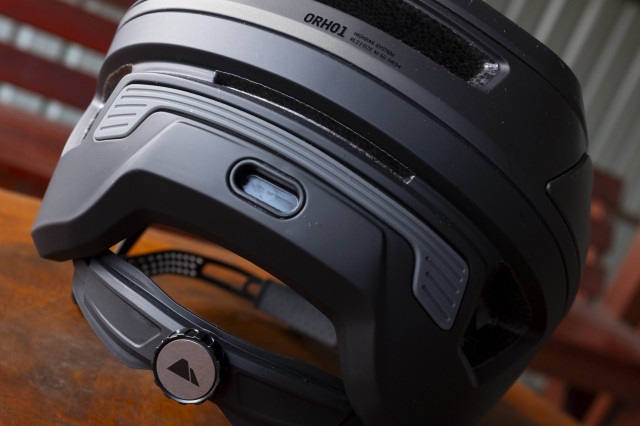
The inner helmet has no rear padding, and there’s a fair “drop off” from the rear pads to the “cradle”, which feels strange and can be a bit irritating, especially when you open your eyes wide, which I find I do a lot off-road. That said, when your focus is on the ride and not on reviewing a helmet that does fade, and following an angry “bee in the bonnet” incident last year, I often wear a cap beneath my helmet now, which banishes the sensation.
The helmet doesn’t feel bulky or heavy, the ventilation is pretty good – but not outstanding, and, after all, this is a trail helmet with safety being prime. The peak is really good and can be switched between the three positions on the go, which I really appreciate when riding in varying conditions. You’re best remembering to remove eyewear when putting the helmet on and removing it, otherwise you may end up with dropped/damaged glasses.
Canyon Deflectr RLS – Verdict
Overall, this is a very good, very well-engineered, well-built, brave and innovative helmet – at a very fair price too. Looks are a personal thing, and let’s face it – anything new and different takes time to accept. I do like the upper helmet look, and even the bold and non-conformist frontal looks – in a very Kraftwerk kinda way. Side on, umm, that’s for you to decide.
As much as I appreciate the inner cradle fit of the HighBar system, perhaps the helmet would be a real winner if a strapped version were also available, with the familiar security feel of having a familiar strap behind your ears. If straps are your thing – and if the perfect auto fit isn’t a worry, then the similarly priced Bontrager Rally MIPS or the MET Terranova MIPS could be worth a look, though the closest in safety rating terms to the Deflectr is the POC Cularis, which costs a whole lot more too.
All said and ridden, I’d say the probable real-world safety advantage, not to mention the fair pricing, make this a helmet well worth taking seriously, and if those stats do relate to real-world situations (and I suspect that they do – at least to a good extent), the Canyon Deflectr RLS really could prove to be a lifesaver.
All the deals displayed on our review pages are pulled from a constantly updating database feed of the best affiliate deals available. The criteria for deciding on what are the best deals is who is offering the lowest, delivered price. In most cases we will be showing the very best deal available online, but sometimes you may be able to find an item cheaper. If you can please feel free to post a link in the comments box below. To find out more about affiliate links on road.cc click here.