


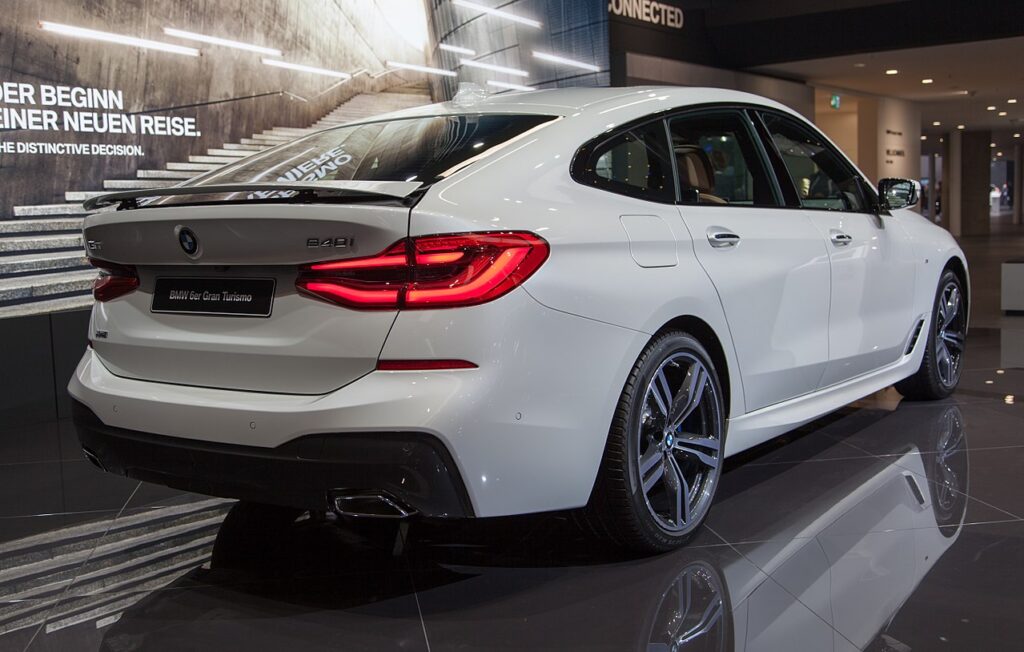

A recent review of the BMW G32 640iGT 2017 by Honest John reveals that when set to semi-autonomously follow road markings, the car will force drivers to execute close passes of cyclists unless they use their indicator.
Honest John writes: “If the road ahead is clear apart from a solitary cyclist, you do need to signal to overtake him, otherwise the steering wheel will fight you and you could pass him uncomfortably close.”
Never use Tesla Autopilot feature around cyclists, warns robotics expert
The flaw touches upon issues raised at last week’s IAM RoadSmart/RAC Foundation/Pirelli ‘Driver Ahead?’ Conference, at which experts sought to “map a safe route to the driverless car.”
Opening the conference, guest speaker Victoria Coren-Mitchell introduced the concept of “death by code,” and challenged attendees to decide whether deaths caused by a computer were better or worse than those caused by human error.
Professor Neville Stanton, Professor and Chair of Human Factors Engineering at Southampton University pointed out that driverless technology also brings the danger of switching the driver from underload to overload – where he or she has had nothing to do, then has to intervene in an emergency situation, only to end up panicking and creating a tragedy.
He said: “The problem with automation is that it is not currently powerful [enough] to render the driver completely redundant. It requires the driver to monitor continuously and intervene occasionally. The car needs to support, not replace the driver.”
There was also concern that some drivers would misuse vehicle systems, or find a way round them because they found them too complicated.
Professor Nick Reed, head of mobility research at Bosch, said: “Any system needs to be aware of the effective use or misuse of it.”
Professor of Human Factors at University of Nottingham Sarah Sharples, added: “People will break unbreakable technology if they find it inconvenient. What’s more, people pranking and having fun will cause security risks.”
Cyclists taking advantage of driverless cars is a worry, says transport consultant
Nic Fasci, lead engineer for vehicle engineering and homologation at Tata Motors European Technical centre, said: “The key to autonomous vehicles is training, training, training. The skill of driving must be robotic before the software can be developed. The skill of driving is being eroded and this can be seen every day.”
Neil Greig, director of policy and research at IAM RoadSmart, concluded that drivers would require a great deal of re-educating before entering the world of the autonomous vehicle.
“There is a myth that the car will do everything for the driver. It is clear the driver will always have a part to play – but is the driver ready for his new role? Clearly not. That’s the reality we have to prepare for.”
In related news, the BBC reports that driverless bus pod tests are now underway in Cambridge.
The RDM Group is testing self-driving pods along the guided busway to gauge the feasibility of running 10-seater shuttles along the route.
Findings will be announced in June 2018.
Richard Fairchild, from the RDM Group, said: “It is segregated from the highway, allowing the pods to whizz up and down without traffic congestion slowing them down. It is also segregated from pedestrians and cyclists, meaning it is a really safe route.”









55 thoughts on “Semi-autonomous BMW will ‘fight driver’ to deliver close passes of cyclists”
Bloody awful, well done
Bloody awful, well done Honest John for highlighting the issue.
Am sure that there we be a typical BMW driver response.
Really? You’re that narrow
Really? You’re that narrow-minded as to assume that bad drive rbehaviour is base don the make f car you drive? Sad…
goggy wrote:
Bingo! And there it is!
goggy]
Well, perhaps you aren’t as observant as you think? Of course BMW drivers aren’t all the same, but a lot of them do seem to want to give the marque a bad name.
So, my enthusiasm for the
So, my enthusiasm for the driverless car as an answer to cyclist and pedestrian deaths is on the wain. People struggle with the level of competence required to drive on our busy roads with current distractions and the need for constant vigilance. THis new model appears to offer greater opportunity for distraction and resistance to the necessary intervention that could save a life. Lose Lose rather than Win Win! At least there will be a chance of a big payout for corporate manslaughter?
Samtheeagle wrote:
This sort of thing is exactly why I’ve never felt very optimistic about ‘self-driving’ vehicles. It means de-skilling drivers and encouraging them to do other things and not pay attention, while still expecting them to be ready to intervene and make critical decisions at any moment.
Plus AI is just harder to do than the hype makes out, and the commercial incentives may not inspire the programmers to give a high priority to the safety of non-customers.
You do hit on the only counter-point – which is that juries are likely to be far harder on corporations than on fellow human drivers, at least when it comes to civil proceedings and financial punishments/compensation. The ‘there but the grace of God…’ factor doesn’t apply if the defendant is a corporation. But on the other hand, corporations can afford the best lawyers.
I wasn’t aware BMWs came with
I wasn’t aware BMWs came with indicators, never seen one in action!
I’ve seen them in use (I
I’ve seen them in use (I believe they are optional extras though)
I was following an X5 into a roundabout and it signalled left (we drive on the right here so he was heading around the roundabout) and promptly turned RIGHT out the first exit… <DOH>
They are also used when parking illegally to scare away parking wardens/attendants.
Most commonly seen though is the 4-way flasher mode, which means “I have a BMW so I can can leave it wherever i want, such as here in the middle of the road and those flashy things mean ‘Yep, that’s absolutely fine’ . . .”
CygnusX1 wrote:
Similar malfunction with Merc’s Audi’s Range Rovers and Prius!
CygnusX1 wrote:
Come with indicators but the controls are on the secret stalks and not many can find them.
CygnusX1 wrote:
I was a passenger in an early
I was a passenger in an early generation driverless vehicle and found the experience deeply alarming. It had so many flaws it was unsafe for the road, though it was used on road with human back-up. The technology has been improved since then, but not enough. The systems are still not sufficiently sophisticated to understand the differing behaviour of cyclists and motorcyclists from four (or more) wheeled vehicles.
AFAIK, what it does is that
AFAIK, what it does is that the steering wheel would vibrate and there would be some very modest resistance/force feedback if you attempted to move cross the white line without indicating. It would not ‘force’ the driver to close pass any more than cruise control would ‘force’ you to drive straight into the back of a queue on the motorway.
This is a long way from autonomous driving, its intended as a driver aid, much like cruise control, lane keeping assist, etc.
Autonomously changing lane on a single carriageway potentially into oncoming traffic/pedestrians will require a degree of human interaction for the time being.
The dream is almost reality!
The dream is almost reality!
I think public understanding
I think public understanding is vital but a lot of the media coverage is vague to say the least when talking about “driverless” cars. I couldn’t quickly find any detailed info on what the BMW is actually doing. All the linked review says about the BMW is:
“You can drive it or you can set it to semi-autonomously follow the road markings.
But a word of warning about that. If the road ahead is clear apart from a solitary cyclist, you do need to signal to overtake him, otherwise the steering wheel will fight you and you could pass him uncomfortably close.“
To me, that is not semi-autonomous; it’s driver assist at most. More formally, I’d say it’s level 1, possibly level 2 (https://en.wikipedia.org/wiki/Autonomous_car#Levels_of_driving_automation). It’s only level 3 and above where you can supposedly stop concentrating.
Personally, the idea of Level 3 sounds inherently dangerous, if it expected that people could be sat doing something else and then take over immediately or within a few seconds.
To be honest, I think level 2 is dangerous enough – if you are driving, you should be concentrating. Expecting people to maintain that attention when they’re not actually doing the driving ignores what humans are like – with the best will in the world, your attention will wander if you’re not directly involved and not expecting to do anything either for 99% of the time.
Levels 4 and 5 though – that is a different matter. Properly done, I am very optimstic about this. My greatest concern is that in a rush to market, level 3 automation will be used inappropriately and unsafely, or that Level 4 or 5 will be released too soon.
Edit: Ninja’d by Andy.
gw42 wrote:
Sorry dude. Great minds and all that though!
|This on top of the youtube
|This on top of the youtube video of the Nissan autonomous vehicle executing a close pass on a cyclist during demo, in spite of passenger highlighting it, the driver did nothing to intervene, having blind faith in the car’s ability to “miss”. No contngency was applied for the cyclist todeviate from his trajectory.
We need to set out minimum
We need to set out minimum requriements for driverless cars to be sold in this country. We already have type approval for cars so it can addded to those tests. If BMW follow this line then their cars can be banned.
Autonamous vehicles are
Autonomous vehicles are claassified 0 to 5; 0 being the Vauxhall Astra you used to pass your driving test in a few years ago, to 5 meaning fully autonomous and can operate in all weathers.
Level 3, where the vehicle takes on most functions, but the driver has to be alert to take back control at any moment, is the most dangerous due to drivers switching off. The insurance industry and Government are of the same opinion on this, that we should skip this level to Level 4 – the next vehicle can operate fully autonamously in all but extreme weather. I work for the insurance industry and have been to meetings with Centre for Connected and Autonomous Vehicles/DfT in drafting legislation for a legal framework for insurance.
Not skipping Level 3 can lead to issues highlighted above, and if drivers do not take back control, then collsions can and will occur, with disasterous conqueuences.
scouser_andy wrote:
Hmm, if drivers have to recognise when the weather is bad and switch to manual drive… good thing they’re really good at that already and switch on headlights when it is dull or raining! Also great that drivers will suddenly have to drive at the time they need the greatest level of skill, but probably won’t have driven normally since last winter so even the basics are getting rusty.
If it either can’t spot a
If it either can’t spot a cyclist it shouldn’t be allowed on the road. And if you have to wrestle it rather than it reverting to driver control it shouldn’t be allowed on the road.
darrylxxx wrote:
Just like the average human driver, then.
I think this is all too focused on a journalist making a throwaway statement about his poor practice to just “nip” round a cyclist when driving rather than indicating and moving fully over into the next lane and giving the cyclist plenty room. With more experience of the car I bet it would be intuitive to flick the indicator negating the issue.
Surely this is an issue with all stay in lane technology esp in combination with cruise control. If this is truely a smart car I’d hope it would also have collision avoidance braking that could detect cyclist and automatically apply the brakes, now that is a technology I’d like to see, esp if it works for cars pulling out of or into junctions (ie. 360 degrees around the car)
I think this is all too focused on a journalist making a throwaway statement about his poor practice to just “nip” round a cyclist when driving rather than indicating and moving fully over into the next lane and giving the cyclist plenty room. With more experience of the car I bet it would be intuitive to flick the indicator negating the issue.
Surely this is an issue with all stay in lane technology esp in combination with cruise control. If this is truely a smart car I’d hope it would also have collision avoidance braking that could detect cyclist and automatically apply the brakes, now that is a technology I’d like to see, esp if it works for cars pulling out of or into junctions (ie. 360 degrees around the car)
It’s worse than you think –
It’s worse than you think – given that UK driving students are currently instructed not to indicate when passing cyclists – not required apparently!
dassie wrote:
Is that true? Good grief… <face-palm>
brooksby wrote:
It was what my daughter was taught in 2016; apparently it potentially creates confusion in the minds of other drivers, who may think the overtaking vehicle might be about to turn into a side road. Possibly derived from HC 103-106 about not making confusing signals.
brooksby wrote:
I understand indicating for the benefit of pedestrians is also not recommended.
wycombewheeler wrote:
Is that true? Good grief… <face-palm>
— brooksby I understand indicating for the benefit of pedestrians is also not recommended.— dassie
You see, now, that explains a lot.
dassie wrote:
I’m sure the instructor was simply explaining that whether or not to signal is a decision that requires a little thought. Each situation is unique and sometimes a signal is essential, sometimes not.
The driver who signals before every discarded cigarette packet is as much a distraction as one who never bothers.
mike the bike wrote:
In most cases a motorvehicle onstructs the view of the following vehicle, thus when overtaking something/one where you would have to change your line significantly when doing so that requires signalling. To use the excuse that it might confuse others oncoming for instance is a load of BS. Either when you overtake there’s enough room for the thing/person you’re overtaking AND oncoming traffic or there isn’t. It matters not then if there is an oncoming vehicle and a junction because the overtaker will have taken the distance and the oncoming driver would have acknowledged they were overtaking another vehicle.
To dumb it down to not indicate when it benefits other road users (particularly thosw behind) in case it sends the wrong message is patently bollocks and sets dangerous precendence.
I guess not indicating for a turn or at a roundabout would also be equally acceptable in the same circumstances?
Clearly for learner drivers it wouldn’t and would lead to a fail in the test, to not signal to overtake is no different a scale, in fact it’s far more important especially around vulnerable road users.
Today, I learned that
Today, I learned that driverless/autonomous now means “having a driver”/heteronomous.
remember that this technology
remember that this technology is still in its infancy, problems like this will crop up and then be solved. no car manufacturer is claiming to have completely perfected a driverless system, it is a work in progress. automatic cars WILL be safer than the very best human drivers ever could eventually and I can’t wait until they’re the norm.
it doesn’t even have to be 100% safe. it only has to be safer than humans are at the moment to be worthwhile.
japes wrote:
But how do you know all that? I don’t get where you get such confidence from.
Also, your last line isn’t quite true. Because even if it’s slightly safer than humans at the moment, would that offset the downsides?
Particularly the downside that a far greater number of people will then choose to get around by motorised vehicles. Thus increasing the power of the motor vehicle lobby and increasing the girth of the nation, and possibly even _increasing_ the danger in total, if not on a per-vehicle basis.
I’m not saying I know with any certainty, I just think it’s not so easy to predict how this will play out and it shouldn’t distract from the idea of just having fewer car journeys.
FluffyKittenofTindalos wrote:
why would it not? it will only get better.
this seems to be arguing that making cares more unsafe for either drivers or pedestrians would be good policy to encourage other forms of travel (would probably be effective tbf!)
i don’t believe there exists a significant number of people whose sole reason to eschew travel by private vehicle is because of safety concerns. I would think the opposite would happen. if we could eliminate safety concerns from cycling (ie automated vehicles are much safer than human drivers and become the norm, which obviously we are still a way from) then i would expect an uptake in cycling.
japes wrote:
How do you know, though? Many past technological promises did not, in fact, get better, because the problems proved to be greater than anticipated. Perfect machine translations between languages, for example, is still not here, many decades after people thought it was just around the corner.
They’re still having trouble getting a robot vaccum cleaner to navigate around a house (like the Daleks, they still can’t do stairs), and that was one of the earliest gee-whizz ideas about what AI could do for us, dating back to the 1960s.
I think there are a significant number of people whose sole reason to eschew travel by private vehicle is because they can’t drive, for one reason or another (lack of confidence, or desire, or aptitude, or being too young or too drunk, or too sleepy, or too lazy…).
Make it easier to take a journey by car and more people will probably take such journeys, whether in preference to taking the bus or to just not making the journey at all.
FluffyKittenofTindalos wrote:
Standards wars: one of the massive obstacles we have here. To have properly driverless cars, and not just a load of driver assist cars like this one trying their hardest to avoid each other (and end up going nowhere), and then panicking and calling for a human, you have to have them talk to each other on a standardised platform. That’s a platform that Mercedes, BMW, Ford, VWAG, Mercedes, Tata, Tesla, Toyota, Land Rover, GMC etc etc have to agree to. By now, anyone with any understanding of standards and how car manufacturers are dodgy money-grabbing bastards will be thinking ‘impossible’. But it gets even more fun.
Throw Google, Apple and, if rumours are true, Facebook and Microsoft into that mix too.
And they have to make cars that either adhere to one standard or somehow work on competing platforms, and all those models need to be able to drive in London, rural Wales, California, Mexico City, Moscow, Paris, Dubai, Beijing, Mumbai, Singapore, Sydney, Tokyo….
And all the relevant regulators need to figure out what the hell is going on and bring in relevant laws and regs for their relevant jurisdictions.
The technology is a piece of piss compared to the politics and power bollocks yet to even begin.
FluffyKittenofTindalos wrote:
Autonomous vehicles should only be introduced in conjunction with a targeted reduction of the overall number of vehicles. And they should be limited to the elderly, infirm and otherwise unable to use public transport or bicycles.
There are just too many people to make individual automobile use viable.
Ush wrote:
Autonomous vehicles should only be introduced in conjunction with a targeted reduction of the overall number of vehicles. And they should be limited to the elderly, infirm and otherwise unable to use public transport or bicycles.
There are just too many people to make individual automobile use viable.— FluffyKittenofTindalos
I think a huge advantage of fully autonomous vehicles would be to smooth traffic flow: imagine a motorway during rush-hour, with cars travelling 1m apart at 50 or 60 mph. They could do wonders for capacity.
But I agree that car-sharing needs to be pushed much more. The number of individually occupied cars during rush-hour is shocking.
davel wrote:
Autonomous vehicles should only be introduced in conjunction with a targeted reduction of the overall number of vehicles. And they should be limited to the elderly, infirm and otherwise unable to use public transport or bicycles.
There are just too many people to make individual automobile use viable.
— Ush I think a huge advantage of fully autonomous vehicles would be to smooth traffic flow: imagine a motorway during rush-hour, with cars travelling 1m apart at 50 or 60 mph. They could do wonders for capacity..— FluffyKittenofTindalos
They are usually called trains. Coaches work quite well also, without needing to replace the road by permanent way. And without the gee whiz (bang?) technology bollox.
oldstrath wrote:
The technology for trains and coaches is already here, and works, yes. Is it solving the problem of getting people out of cars?
davel wrote:
Autonomous vehicles should only be introduced in conjunction with a targeted reduction of the overall number of vehicles. And they should be limited to the elderly, infirm and otherwise unable to use public transport or bicycles.
There are just too many people to make individual automobile use viable.
— Ush I think a huge advantage of fully autonomous vehicles would be to smooth traffic flow: imagine a motorway during rush-hour, with cars travelling 1m apart at 50 or 60 mph. They could do wonders for capacity. But I agree that car-sharing needs to be pushed much more. The number of individually occupied cars during rush-hour is shocking.— FluffyKittenofTindalos
Tell me, how many vehicles would be involved in the world’s most horrendous pile-up if the vehicles were all going at 60mph @ 1m apart and one of them develops a serious fault and crashes into one of the other car-trains?
kie7077 wrote:
Gladly: a metric fuckton fewer than the number of cars that will crash on UK roads today, because ‘people’.
kie7077 wrote:
What kind of serious fault are you thinking of? As the vehicles would all be travelling at the same speed and could all hit the brakes simultaneously (and the same amount), then I suspect that the actual damage caused would be slight.
Things do go wrong, but it’s easy enough to build in safety protocols that the computers can follow to limit catastrophes – as opposed to humans who can’t always remember to indicate when turning.
japes wrote:
Teething problems are OK when you have a call centre to help customers with the bits that go wrong.
In the context of self-driving cars this becomes deadly complacency, I don’t want dead cyclists to be the price to pay for the improvements.
japes wrote:
But is it really safer if it needs a driver to sit there doing nothing and then expect him/her to suddenly pay attention and react? Surely the driver will doze off/get bored/mind wander/fiddle with phone etc? It’s bad enough now on motorways when people switch their brains off.
This isn’t about semi
This isn’t about semi-autonomous cars, this is ‘lane-keeping assist’ and it’s available in most cars on the market now – I think all 2018 Fords have it as standard. It’s in my car, and if it’s switched on it will lightly resist crossing a white line to either side. You can force it to, of course, and if you indicate then there’s no resistance. But really there’s no need to have it on unless you’re on a motorway or dual carriageway.
Come on people, at least have
Come on people, at least have the decency to give them their proper name. It’s “The BMW X5 Twatbox”.
How can these systems even be
How can these systems even be allowed in a live environment when there are obvious safety issues!
We have overtly bright headlights that make driving dangerous far too often, systems that encourages speeding/going too fast for the conditions and by design ignore vulnerable road users and indeed in the case of the Mercedes system will deliberately crash into omore vulnerable/exposed road users than put their occupants at any risk of harm.
DfT are such a bunch of cunts allowing these so called advancements
@Fluffy “But on the other
@Fluffy “But on the other hand, corporations can afford the best lawyers.”
corporations can afford the best LAWmakers …
@gw42 “Personally, the idea
@gw42 “Personally, the idea of Level 3 sounds inherently dangerous, if it expected that people could be sat doing something else and then take over immediately or within a few seconds.”
from what i see everyday, some drivers think their car is already at Level 3 …
I’m not going to bother
I’m not going to bother checking whether I’m the first to say, “I thought BMWs were already fitted with this feature as standard.”
So the programmers have
So the programmers have managed to duplicate perfectly what most human drivers do; pass cyclists dangerously. Perhaps we need to cull this lot of programmers and replace them with cyclists.
“It is clear the driver will
“It is clear the driver will always have a part to play – but is the driver ready for his new role? Clearly not. That’s the reality we have to prepare for.”
If it’s clear that the driver will always have a part to play then we should all be quite afraid. There’s pretty only one way in which an autonomous car is viable from a safety point of view, and that’s when the driver has no role to play in safety (which is levels 4 and 5 of automation). The “underload to overload” problem is so blindingly obvious that it’s beyond comprehension that the industry could ever contemplate level 2 and level 3 automation as a stepping stone to levels 4 and 5. Even level 1 is pretty problematic: the BMW issue in the article is a level 1 issue.
It’s very easy to be optimistic about autonomous vehicles if you imagine the eventual scenario of every car on the road being at level 5. But getting to that point, if that’s even possible (and the main obstacle to that is not technological but societal), is going to be very, very painful in myriad ways.
This is wrong in so many ways
This is wrong in so many ways. Some points:
A steering wheel should not be fighting what the driver wants to do period. That sounds incredibly dangerous both to other road users and to the vehicle occupants.
Lane following is a simple technology that probably shouldn’t be allowed anywhere other than on motorways.
If the lane following tech can’t do safe passes then it shouldn’t even legally be allowed.
The lane following technology should have disengadged when there was a hazard up ahead, why didn’t it? Lane following technology is over-simplistic, it looks for lines on the road and follows them, clearly that’s just not good enough.
If BMW et al don’t fix this pronto then they fully deserve a law suit the next time someone is killed / injured and there should be punitative damages to deter companies from deciding it’s worth it to kill and injure people.
It looks like car manufacturers are adding semi-autonomous tech to their vehicles without any kinds of standards. Number 1 priority should be that any autonomous system must follow the law and highway codes, it looks to me like this car has failed in that respect. This needs to be enshrined in law if law doesn’t already cover it.