

- News
- Reviews
- Bikes
- Accessories
- Accessories - misc
- Computer mounts
- Bags
- Bar ends
- Bike bags & cases
- Bottle cages
- Bottles
- Cameras
- Car racks
- Child seats
- Computers
- Glasses
- GPS units
- Helmets
- Lights - front
- Lights - rear
- Lights - sets
- Locks
- Mirrors
- Mudguards
- Racks
- Pumps & CO2 inflators
- Puncture kits
- Reflectives
- Smart watches
- Stands and racks
- Trailers
- Clothing
- Components
- Bar tape & grips
- Bottom brackets
- Brake & gear cables
- Brake & STI levers
- Brake pads & spares
- Brakes
- Cassettes & freewheels
- Chains
- Chainsets & chainrings
- Derailleurs - front
- Derailleurs - rear
- Forks
- Gear levers & shifters
- Groupsets
- Handlebars & extensions
- Headsets
- Hubs
- Inner tubes
- Pedals
- Quick releases & skewers
- Saddles
- Seatposts
- Stems
- Wheels
- Tyres
- Health, fitness and nutrition
- Tools and workshop
- Miscellaneous
- Buyers Guides
- Features
- Forum
- Recommends
- Podcast
 Riding in ice and snow-5.jpg
How to ride your bike through ice and snow — top tips for safe cycling when the mercury drops
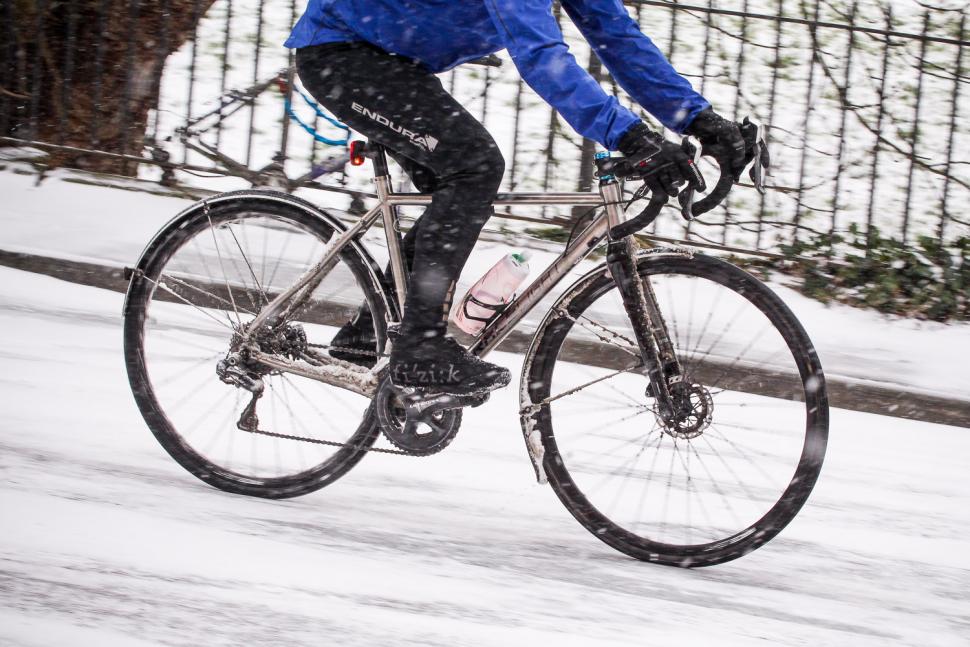
When the temperature drops, roads develop a new hazard: ice and snow. Some choose not to risk it, and hang up their bikes for the frozen season, but with the right preparation you can keep riding all through winter. Every winter we re-publish our guide to riding when winter is at it's worst. It comes complete with many years worth of your comments too, there's plenty of wisdom in there.
Some winter survival tips are about preparation, some about riding technique. Let's get your bike sorted out first.
Before you ride
Maximise your contact patch. Fitting fatter tyres, and running them at lower pressures, will increase the size of your contact with the road, so go for the fattest that will fit your frame. If you know you're going to be riding in snow, then a treaded tyre or even a lightly knobbed mountain bike or cyclocross tyre will give extra grip.
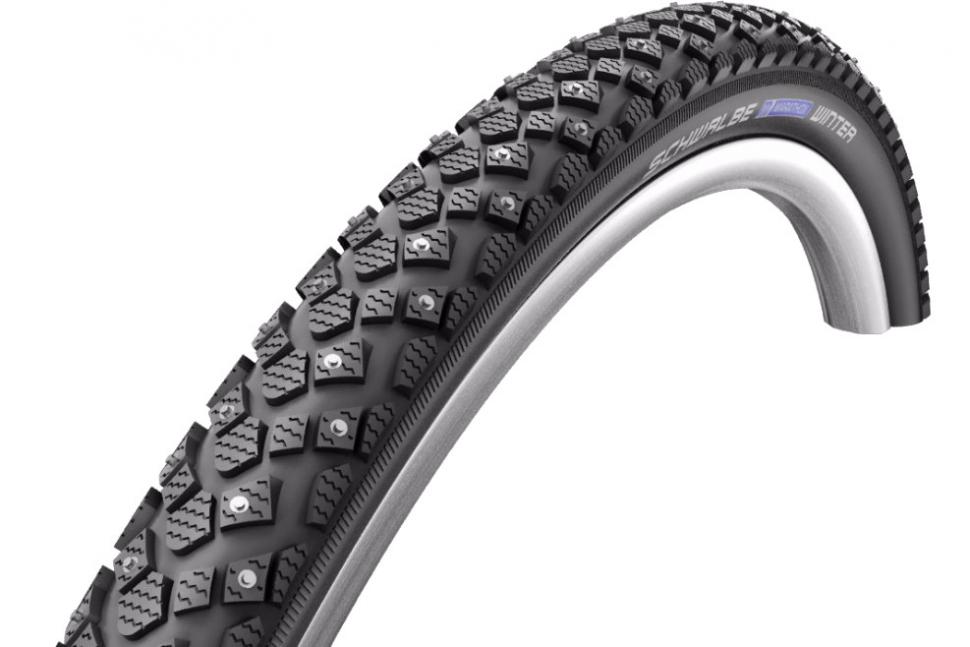
Get studded. Even the best tyres won't grip sheet ice. If you think you're going to encounter proper black ice — which has a nasty habit of lurking at the bottoms of hills on minor lanes and anywhere water runs off fields — then get some studded tyres like Schwalbe Marathon Winters or Continental Nordic Spikes.
Go tubeless. The main benefit is that you can run super-low pressures for ice, and not risk punctures. You can buy specific tubeless rims and tyres, but we've had good results with standard rims, tyres, some sealant and a roll of electrical tape. You can only run the DIY version up to about 50psi, but that's more than enough for ice & snow.
Read more: Buyer's guide to tubeless wheels
For even more bike winterising tips check out road.cc's guide to winter-proofing your bike
Flat pedals. You may sacrifice some pedalling efficiency, at least until you get used to the different feel, but you are buying get out of jail extra control if things go wrong. If you can't live without clipless pedals, then loosening the release tension is another option and double-sided mountain bike pedals with recessed cleats in the shoes are good.
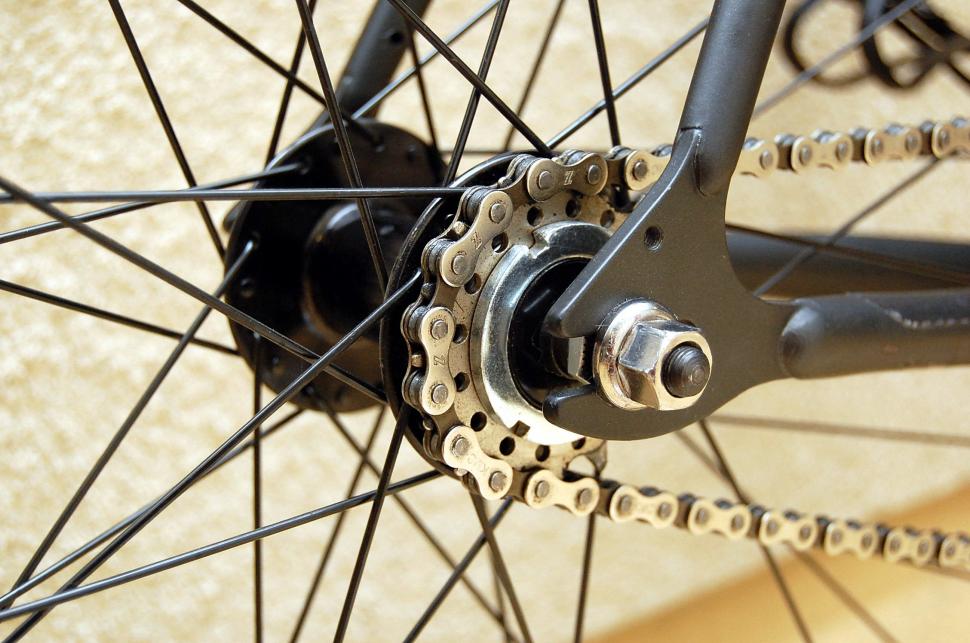
Ever thought about a fixed? This is the time of year when continuous drive really does come into its own – a fact known to old school roadies through the ages. You can slow a fixed bike down on ice without using the brakes and while maintaining traction and power to the back wheel. That's a very good thing when it's slippery.
Get down! Some people suggest that you lower your saddle slightly, so lowering your centre of gravity. The other advantages of dropping the saddle are that it's easier to get your feet down flat on the road should you suddenly need to use God's stabilisers, and less dramatically but just as usefully it makes it easier to start off sitting in the saddle when things are really slippy. That extra weight can the be difference between the getting the traction needed to move and having your back wheel slip with potential painful top tube consequences.
Did we mention it's cold? An extra layer on top of what you would normally wear in winter is a good idea. Not only is it much colder than most of us are used to but the state of the roads means you are likely to be riding slower than your normal pace, so you may not be generating the same levels of heat.
Pay particular attention to your hands and feet
Feet: overshoes, thermal socks and winter boots are all a good idea. Cold feet make for a miserable ride. It's tempting to put extra socks on but layering outside the shoes keep blood flowing to your toes and your feet warmer.
Struggle to keep your feet warm? Check out this guide to warm socks, overshoes and more.
Hands: It's even more important to keep these warm than your feet – trying to control your bike with two blocks of ice on the ends of your arms is not pleasant on any level. Good gloves are a must and glove liners – even inside thermal gloves if you feel the cold – are a good idea too, as are covers over the brake levers and grips (if your bike has flat bars). The benefit here is twofold: not only do they reduce the windchill to your hands but they also reduce the chilling effect on metal brake levers and bars with thin grips. Metal conducts the cold very efficiently, an argument if ever you needed one for upgrading to carbon levers or taking the budget option with some plastic ones.
Shopping for gloves? Have a look at our Buyer's Guide to winter hand warmers.
On the road
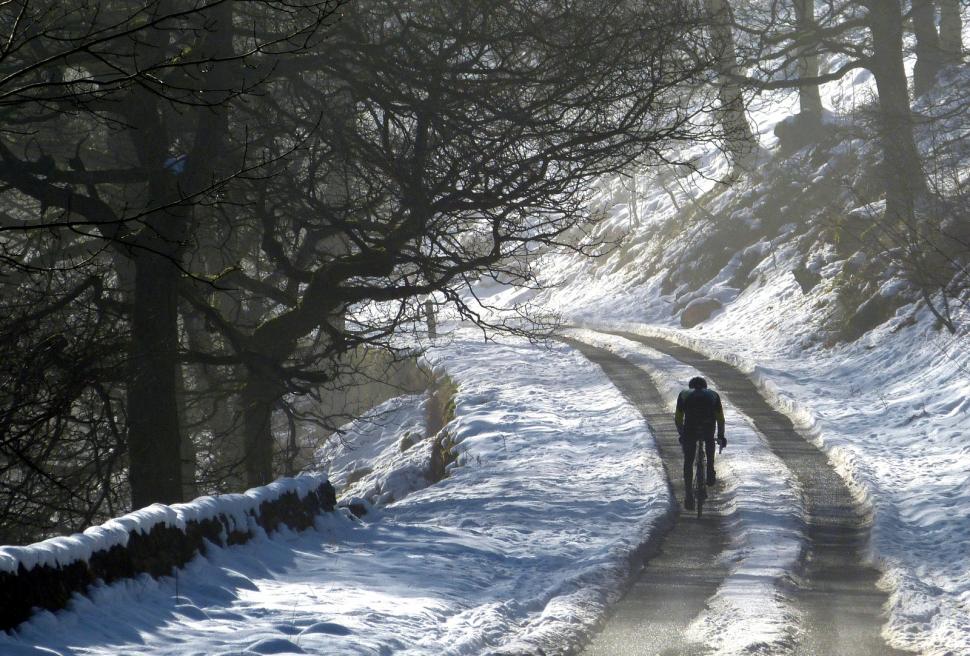
Cycling Up To Derbyshire Bridge (CC BY 2.0 arg_flickr|Flickr)
Choose your road. You may normally keep to the quieter back roads, but they aren't usually gritted when the ice and snow hits so in terms of keeping upright they are going to be the most difficult. The main roads will be clearer, even so you still need to take care.
Keep away from the kerb. Riding too close to the kerb is not a good idea at the best of times. It limits your room for manoeuvre and it's where all the crap from the road tends to accumulate. Even on major roads, the edge may not have been well cleared of snow, and it's where water pools and freezes so in winter it becomes a real no-no. Where main roads cross minor ones the ice and snow often fans out from the side road in to the carriageway and if you are going to fall off you don't want to be doing it within head cracking range of a kerbstone.
Give yourself longer to stop. It takes longer to stop safely or even to slow down on icy surfaces. Factor that in to your calculations when approaching junctions or making any other manoeuvre that is going to involve slowing down or stopping. It's amazing how quickly most people's brain's make this adjustment.And remember it's going to take other people longer to slow down too.
Get a disc-braked bike. If you're setting up a specific winter bike, then the extra stopping power and control of disc brakes makes them a no-brainer, and they're less affected by the wet than rim brakes.
Choose your line. If you can. The simplest way of avoiding problems when riding on icy roads is to choose the dry line. One recent winter saw very cold but dry weather in much of the country, so the roads weren't uniformly covered in ice. Instead, it was lying in patches on the road or in gutters, or it was run-off that had frozen across the road so the dry line wasn't always a straight one. Another year, sticking to the dry line was simply impossible, because compacted snow on untreated roads had just frozen. That's when you have to cope with actually riding on the ice.
Riding over ice
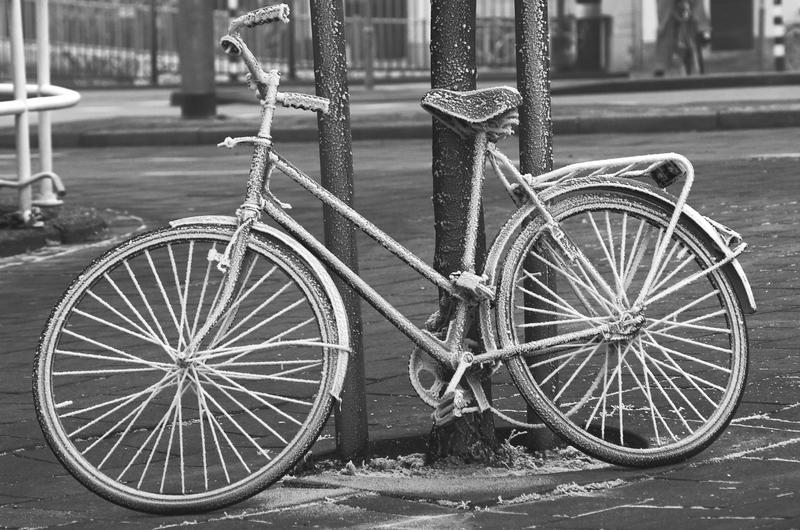
Lay off the front brake. Most of us know the old mantra “your front brake is for slowing down, your back brake is for stopping” but the bit that usually gets missed out is “except on ice where you really don't want to be losing any of your front wheel's traction. At all.” Haul on the front brake going over ice and any loss of control at the front is going to be sudden and very hard to recover from.
The ideal thing to do if you find yourself riding across a stretch of icy road is to smoothly pedal through it. If you need to slow down, the ideal thing is to be on a fixed. If you're not on a fixed then gentle braking on the back is your best bet. In countries where ice is more the norm some cyclists practise making the back step out under hard braking so that they will know what to do when it happens on ice. If you do feel the need to use the front brake use it along with the back and do it so lightly that the front wheel never stops rolling. We're talking gently scrubbing off speed, as we've already said you really don't want to lose traction at the front.
If the back does step out under braking the first thing to do is stop braking, you also need to make an instant decision to either pedal, or get a foot or even both feet down.
Choose your line. Again. Yes we already said that, but there's more. If there is a worn or dry line through the ice try to use it, but you may need to make a call here because the dry line may not be in the place you want to be on the road so you will need to proceed with caution. This situation is more likely to apply on minor roads or ones with a steep camber on which heavier vehicles have worn away the ice and snow more on one side; on these roads you would hope that other road users would also be proceeding with extreme caution too.
Don't let your natural desire to stay on your bike at all costs cloud your judgement. The other thing to consider when choosing your line is the camber of the road. Many of our local roads have a steep off camber that's fine under normal conditions but when it's icy means that not only is the ice against you but so is gravity because you are trying to ride across a slope and your tyre's contact patch is on the side rather than directly underneath you. The best place to be from a traction point of view is on top of the camber which is right in the middle of the road. It may actually be the only place that's rideable. If it is, use your common sense. On quiet straight roads where you can see and be seen it may be doable, otherwise get off and walk to the next section where you can ride. There's no dishonour in dismounting.
Keep it smooth. Avoiding sudden changes of direction and maintain a smooth pedalling action – it really pays off. Many experienced ice riders also say that you shouldn't ride in too low a gear mainly because it's harder to keep things smooth if you are really spinning the pedals – and potentially the back wheel.
Keep pedalling. Try keeping both feet on the pedals while you are moving. However, you may want to be able to get your feet off quickly to dab the ground and help in correcting any slides. The suggested method of dealing with your front wheel sliding is to relax your ankle on the opposite side to the slide and either dip your knee out or dab your foot to drag the bike out of the slide. In our experience though though this is only going to work at lower speeds, so you might want to keep it down.
Don't panic! Keep your head, neck and shoulders relaxed . What you don't want to do is to stiffen up and get twitchy… twitchiness can cause problems.
If you're properly equipped riding in the ice and snow is good fun — no, honestly, it is — but it's not compulsory. You won't get a medal for it so if you think conditions are too tough give yourself a break and get the bus/tube/walk or stay at home and noodle about on your favourite road cycling website… hopefully that's this one.
Of course, now you've read this it should start warming up any minute! In the meantime if you have any ice riding tips don't be shy - get on here and share them with the rest of us.
road.cc's founder and first editor, nowadays to be found riding a spreadsheet. Tony's journey in cycling media started in 1997 as production editor and then deputy editor of Total Bike, acting editor of Total Mountain Bike and then seven years as editor of Cycling Plus. He launched his first cycling website - the Cycling Plus Forum at the turn of the century. In 2006 he left C+ to head up the launch team for Bike Radar which he edited until 2008, when he co-launched the multi-award winning road.cc - finally handing on the reins in 2021 to Jack Sexty. His favourite ride is his ‘commute’ - which he does most days inc weekends and he’s been cycle-commuting since 1994. His favourite bikes are titanium and have disc brakes, though he'd like to own a carbon bike one day.
Latest Comments
- Cugel 4 min 1 sec ago
Let's be blunt - this website is a conglomerate of shock-horror "news stories" for cyclist allied with a load of pretend-reviews that are obviously...
- Miller 0 sec ago
> getting these shoes on and off is uniquely demanding...
- slc 10 min 15 sec ago
I have been thanked for stopping at a red light precisely once. By a pedestrian keen to point out that they had never previously seen a cyclist...
- mattw 12 min 36 sec ago
TBF close together constituencies.
- ROOTminus1 15 min 37 sec ago
Only if you're using him to replace the force sensors in an impact test
- David9694 18 min 28 sec ago
Young man arrested after van crashes into Cheltenham police station at speed...
- David9694 22 min 12 sec ago
See also https://davewalker.com/ and https://bikeyface.com/
- OnYerBike 56 min 10 sec ago
They are probably SKS Bluemels. Most mudguards are SKS Bluemels (it's like the opposite of the "hoover" effect - most people's vacuum cleaners aren...
- Jack Sexty 1 hour 8 min ago
We're just asking the question. It might be shit and get a bad review, who knows.
- chrisonabike 1 hour 33 min ago
Shurely "True British patriots have second homes in warmer countries and fly there wooly jumpers and English Roadsters"?
Add new comment
124 comments
Spiked tires. They're a pain 95% of the year (where I am) because noisy, draggy, heavy, fast-wearing but when it's freezing and there's snow/ice they're the only game in town.
They're hard times get hold of in the UK because so few people need or want them. I have some schwalbe studded tyres which I ordered from Rose in Germany. Even with the international shipping a pair cost about the same as buying a single tyre would have cost in the UK.
Even then it can bite you.. I used to commute all year around between Edinburgh and Livingston, low tread tyres on a single spped and only ever had a few offs over the years due to ice but always bounced. Last December, 6:30am on a cold morning ... I had just negotiated the worst coner on the commute only to find it relatively ice free. The next corner, a long sweeping left hander that 'was' always fine had a big sheet of black ice on the apex. Front wheel went, I hit the deck. Got back up but couldn't get on the bike.. I'd broken my femur and now have a bunch of metal work in my left hip area. It has left me nervous of ice and in pain most days. Still cycling but now avoid bad days.
Simple, you just apply less power than you need to sustain your speed, but just keep it all rolling along with more feel as to what's going on.
Today's lesson is that if you scrape along a kerb hidden in the snow, you're going to fall off, but with a slippy landing it will hurt less than you expected (but not much)
In the UK I'd generally agree you need more caution if your council don't deal with snow / ice effectively. My one does manage to do grit some cycle paths and even cleared the cycle lanes (once). Not everywhere was safe though.
If there is sufficient snow and separated facilities it's actually fine (look at what they do in Finland).
I wish I knew. In about a decade of winter commuting (ice, snow, temperatures sometimes down to -30 °C) I've had the snow pack up so tight under there that I could no longer pedal maybe two or three times. It seems when conditions are perfect for it, it's going to happen. Some kinds of snow don't even begin to build up in there, some start packing it full instantly. If you can't increase the mudguard clearance, you'll get stuck.
If it's a disc brake bike with 700C wheels, you could get a 650B wheelset and keep winter tyres on it of a comparable width, that would gain close to 2 cm of clearance (but beware pedal strike due to the same amount of bottom bracket drop.) You could even go a little wider for just 1 cm of extra clearance and BB drop.
Even worse than snow in the mudguards was the time the air must have cooled my bike to well below freezing, but it hadn't been freezing for long so there were still some liquid puddles. I rode through a two inch deep puddle and the water instantly froze to my tyres, rims, and cantilever brake pads! The layer was at least a couple of millimetres thick. That took a good ten minutes of chipping away before I could start riding again, not fun when the air is below -10 °C.
Sadly I don't get paid if I don't show up for work so I ride regardless of the weather but obviously there is always the option to get off and walk the most dangerous bits.
I do however get full pay for up to 6 months if I'm off sick so it's swings and roundabouts I guess.
There is also something very satisfying in getting about when the snow is so bad all the motor vehicles are stuck.
Using fixed wheel to slow down gives you better feel of when the tyre is about to slip, the brakes will lock the wheel before you realise and then you have to release them to try to gain traction again.
Up in North Lancashire now the roads are slush if they've had any traffic and are now starting to freeze hard. The pavements and footpaths over fields and by the canal were converted to knobbly sheet ice by overnight sleet falling on previously dry frozen ground and even at midday were difficult to walk on. The pavements were almost impassable at the trivial sideways gradient where the kerbs have been removed for house exits, so everybody was walking on the slushy roads. I've got pretty good fixed feet and I'm having to do tiny steps to stay up without Microspikes on, so these fixie riders must be really good.
.
Yup, Beacon Fell is brill, isn't it?
.
Using fixed wheel to slow down gives you better feel of when the tyre is about to slip
I'm never going to be in any position to dispute this and I'm 70 already, and I think it highly likely that the great majority on here won't be riding fixed and never have. I think a substantial period of learning would be required before the tyro will experience this 'better feel' on an icy road
I recommend a trike! Safer than walking, lower height to fall from if you did AND potentially much warmer if you put a cover on!
https://www.aviewfromthecyclepath.com/2016/01/sometimes-winter-weather-i...
I have ridden a unicycle (they're inevitably fixed wheel apart from some crazy designs) in the snow and you do get a feel for the amount of grip until you suddenly don't have any. It kind of works as a single tyre at high pressure can cut through thin ice to reach the underlying surface but turning is tricky as you need to keep it really smooth (one method of turning involves twisting your hips which is great for manouevrability but useless for snow).
Never too late to learn and the Fylde is a great place for fixed with rolling countryside rather than big hills.
Nice theory, doubt it works with black ice, you'll be picking yourself off the tarmac before you even knew you'd lost traction.
Its not magic, it only works with the grip there is so if you don't know you're on black ice and try to turn you will still come off but if you do know you can hold a straight line and gradually slow down. As others have said you do need some experience but then you're not really a cyclist if you can't ride fixed are you
I used to see an old boy around town who had a small scrubbing brush taped to the underside of his mudguard just off the tyre for that purpose, unfortunately never saw him in the snow so I don't know how effective it was.
Remove the mudguards for riding in snow. You'll likely be wearing a waterproof coat, so having snow kicked up from your back wheel shouldn't be much of an issue.
Thanks to everyone.
TBH Peter, I don't seriously imagine for one single solitary moment that we'll get snow here in Bristol. Ever again...
I live in hope for some as the weather is doing crazy things nowadays
Buy a pair of studded tyres ... they will last several years, so well worth it if you really must cycle in sub-zero temps. I won't go out in standard tyres when there is any risk of ice ... its far too dangerous, particularity when mixing with other traffic. Yes, I'm a wimp...
Up to now we have had no s**w or b***k i*e anywhere on my commute in but I doubt it will keep that way much longer
Has anyone found there rear mech front mech sticking / moving slowly when changing during the cold weather? I thought mine was just muck that had sprayed up from the road but checked them both when I got back home and both were muck free and worked ok indoors once it had been in the warm room after about 30 mins.
These tips are great but after coming off a few times on ice and more recently just in the wet I can't help but tense up a little when I'm unsure of whats beneath me.
The times I have come off have been when turning so the wheels haven't been straight but I get nervous in a straight line sometimes now. Flat pedals are a really good idea, at least you have half a chance of getting a foot on the floor if things start going pear shaped and if you do need to walk for a bit you can do it easily.
Every year you come put with this and every year like an admonishing parent I say "advice for riding on ice? Don't do it!!"
I came off in dry warm conditions 2 months ago at 10 mph, broke 2 ribs and was off the bike for 3 weeks. I've come off twice on ice: Once on the way to a club run when I didn't realise it was icy. Skinned an elbow but nothing broken.
The second time was on a CX bike when a mate and I thought we were on clear road and then looking back we could see that the whole road caught the light and was just ice. I came down so fast on that occasion I didn't realise I had come off until I found myself sitting in the road. Knackered helmet where I'd whacked the back of my head on the ice and a stiff neck for 3 days. So. Just leave it! It aint worth it.
On the other hand - riding on snow on a CX or mountain bike is safe when it's new and lots of fun - so go ahead with that. Just wrap up warm.
I was riding down a minor road on the North Downs last winter on my CX with studded tyres, it was sheet ice - a Range Rover came around the corner, skidded as it braked and ran into the opposite verge. The trouble is 4x4 drivers don't appreciate that big, heavy vehicles are harder to slow down.
I've listed my own set of guidance for ice and snow conditions below:
1. Get permission to ride from neighbour and/or property occupier.
2. Lay down turbo trainer mat.
3. Change in blue turbo trainer tyre
4. Set-up turbo trainer.
5. Don't forget to set up the circulator fan.
6. Ensure that all paintings are firmly placed and don't catch the fan draft, dropping on you and smashing expensive whiskey everywhere.
I was supposed to be doing the Chieveley ride this morning but they cancelled due to the adverse conditions.
REALLY glad I spent a few hours fixing up my old 80's el-cheapo steel MTB a few weeks back - huge wheels, vast knobbly tyres, & stupidly low gearing - done me proper proud on my 10 mile commute in the snow today - deffo way quicker than the car's I passed, - what price an old dodgy BSO now eh?
Schwalbe Ice Spikers. Bought in a summer sale 4 years ago, just before the latest spell of hard winters.
Out tomorrow for 60km off road. It's become something of a regular winter ritual and is about the most fun you can have with your clothes on!
Icy cobbles.
Almost impossible to even push the thing without it rocketing onto it's side - never mind RIDE it.
Oh - and:
Beware of slalom-ing cars. In my experience, they'll rather slide into a cyclist than into another car. We're softer.
Be careful out there people - and good luck!
Happy 2013.
Pages